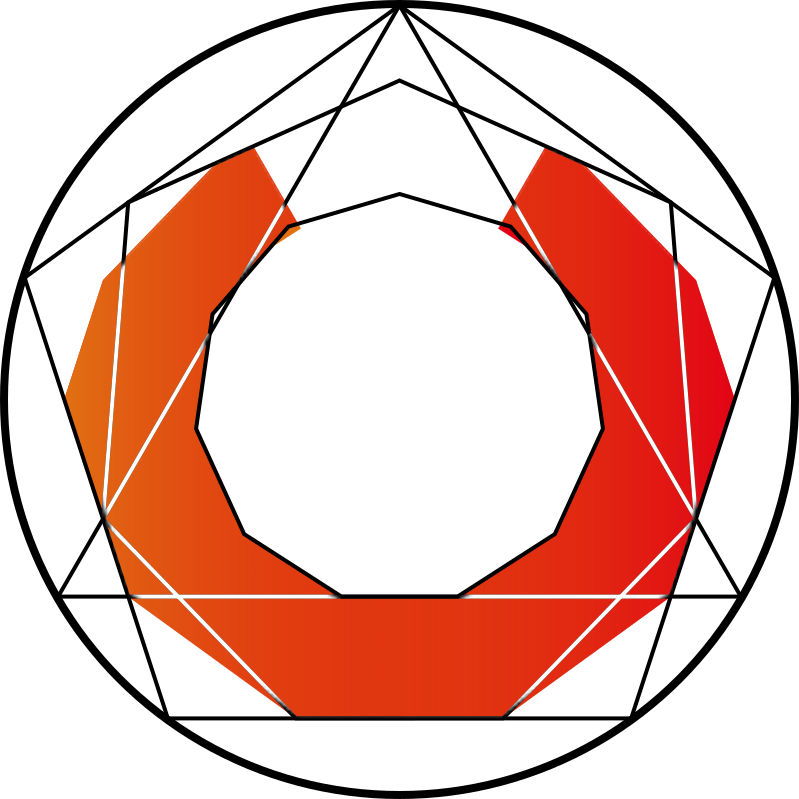
Polymetric Phase Equivalence
Polyrhythm vs. polymeter
At rhythmic timescales, there is a distinct macroscopic difference between polyrhythm and polymeter:
- Polyrhythm: Subdividing a fixed master loop or period into different equal parts (e.g., 4 evenly spaced beats and 3 evenly spaced beats occupying the exact same total duration).
- Polymeter: Running different fixed-length bar cycles out of phase (e.g., a bar of 4 beats and a bar of 3 beats running at the same tempo, aligning only every 12th beat).
Crossing the Temporal-Place Limen
The core thesis of polymetric phase equivalence is that once the inter-onset interval ($i$) accelerates past the Temporal-Place Limen into audio rates, the distinction between polyrhythm and polymeter ceases to exist.
When the cycles happen fast enough to be perceived as pitch rather than individual rhythmic events, our auditory system no longer tracks the macro-alignment cycle (the “downbeat”) as a structural boundary. It only perceives the constant frequency ratio between the two periodic signals.
Mathematical equivalence
Both methods mathematically generate the exact same frequency ratio. For example, a 4-against-3 polymeter aligning every 12th beat yields the exact same 4:3 pitch interval (a Perfect 4th) as a 4:3 polyrhythm. The phase relationship shifts continuously in the polymetric case, but the fundamental ratio of their frequencies remains 4:3. Because the phase alignment occurs below the threshold of temporal resolution at audio rates, the resulting interval identity is indistinguishable.
See also
Knowledge Graph
status: stable