Glyph Forms
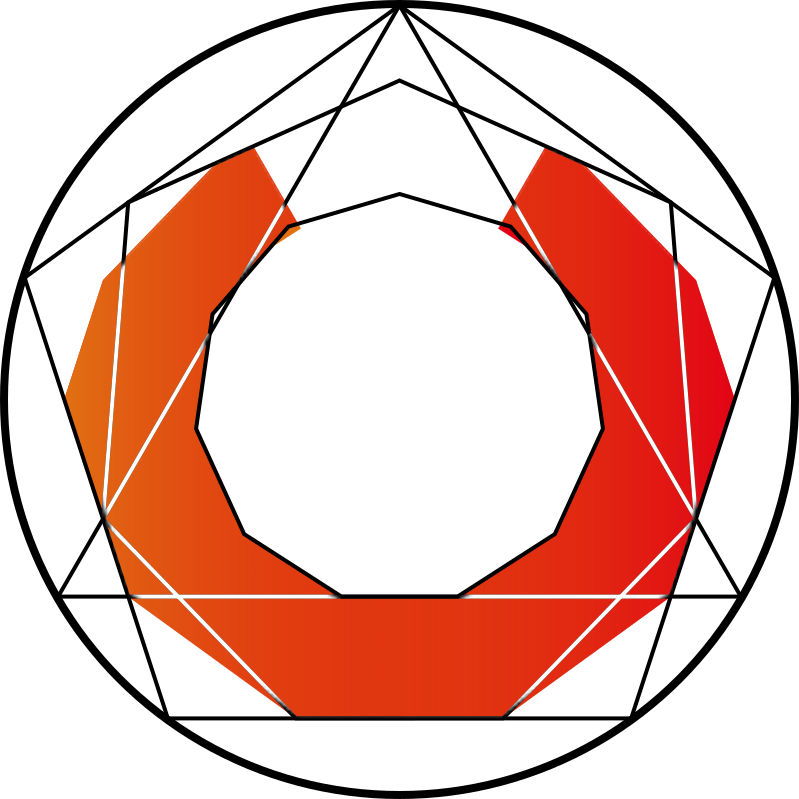
This file specifies the visual form of each diacritic. The base figure (a circle in generic PPD; the rotated U with decorated arms in Uniform Solfège) is treated as a clock face. Orientation is from 12 o’clock (base position). 3 o’clock = positive deviation. 9 o’clock = negative deviation.
Du family
Axis — a horizontal stroke passing through the base character.
Fractal Du depth is encoded as small triangle offsets on the Axis stroke:
- Depth 1 (±1/2): plain stroke, no triangles
- Depth 2 (±1/4): one small triangle pointing to the perpendicular cardinal point (left for negative from midpoint, right for positive from midpoint)
- Depth 3 (±1/8): one small triangle oriented perpendicular to the axis stroke (Up for positive, Down for negative) indicating which side of ±1/4 the position falls
- Depth 4+ (±1/16, etc.): additional triangles continue to subdivide the space, creating a visual bitmask that navigates a binary tree
Tri family
Glyph: equilateral triangle attached at the base character perimeter. Point at 6 o’clock (Base side, pointing away from Axis).
- TriSup (+1/3): 2 ticks on the clockwise side (positive)
- TriSub (−1/3): 2 ticks on the withershins side (negative)
AxisTri
Glyph: equilateral triangle attached at the base character perimeter. Point at 12 o’clock (Axis side, pointing toward Axis).
- AxisTriSup (+1/6): 1 tick on the clockwise side
- AxisTriSub (−1/6): 1 tick on the withershins side
Tick count encodes proximity to the period midpoint — fewer ticks indicates closer to centre. This is consistent with the Sep glyph convention.
DuTri (compound)
DuTri is not a prime family. It is the compound of Tri and AxisTri, providing six equal divisions of the period. Its motivation is coverage of the 72 EDO grid from 12-tone solfège anchor points. The glyph forms for DuTri are the Tri and AxisTri forms used together; there is no independent DuTri glyph.
Qui family
Glyph: triangle (same orientation encoding as Tri) with an outward-facing T-cross (capital T shape) on the diacritic, pointing away from the base character. Tick count encodes magnitude.
- QuiSup (+1/5): point-up triangle + T-cross, 1 tick
- QuiSub (−1/5): point-down triangle + T-cross, 1 tick
- QuiSup2 (+2/5): point-up triangle + T-cross, 2 ticks
- QuiSub2 (−2/5): point-down triangle + T-cross, 2 ticks
Sep family
Glyph: tick(s) or Axis stroke capped with a circle, placed on the 3 o’clock side (positive/clockwise) or 9 o’clock side (negative/withershins). The Axis stroke variant makes the Axis-proximity principle visually explicit.
Clockwise configurations (mirror for withershins):
- Sep (+1/7): 1 tick, capped with circle
- Sep2 (+2/7): 2 ticks, capped with circle
- Sep3 (+3/7): full horizontal stroke (Axis-inherited form), capped with circle
Note: Sep3 deliberately shares visual grammar with the Axis glyph, reflecting its positional proximity to +1/2.
Undec family
Glyph: moon-phase forms placed at the cardinal points (3 o’clock for positive, 9 o’clock for negative). Two poles of gravity: Base (0) and Axis (+1/2). Half-circle (crescent) forms lean toward the nearer pole.
Full moon appears at the cardinal point and represents the centre of the positive or negative field (+3/11 or −3/11). Half-moons offset by Undec steps toward Base or Axis.
Clockwise (positive) configurations (mirror for withershins):
| Glyph | Position | Form |
|---|---|---|
| Undec1 | +1/11 | Double moon leaning toward Base |
| Undec2 | +2/11 | Moon leaning toward Base |
| Undec3 | +3/11 | Full moon at cardinal (3 o’clock) |
| Undec4 | +4/11 | Moon leaning toward Axis |
| Undec5 | +5/11 | Double moon leaning toward Axis |
“Double moon” = two half-circle forms; signals proximity to an extreme (Base or Axis). Undec4 and Undec5 visually inherit Axis-proximity grammar consistent with the design principle.
Knowledge Graph
status: stable