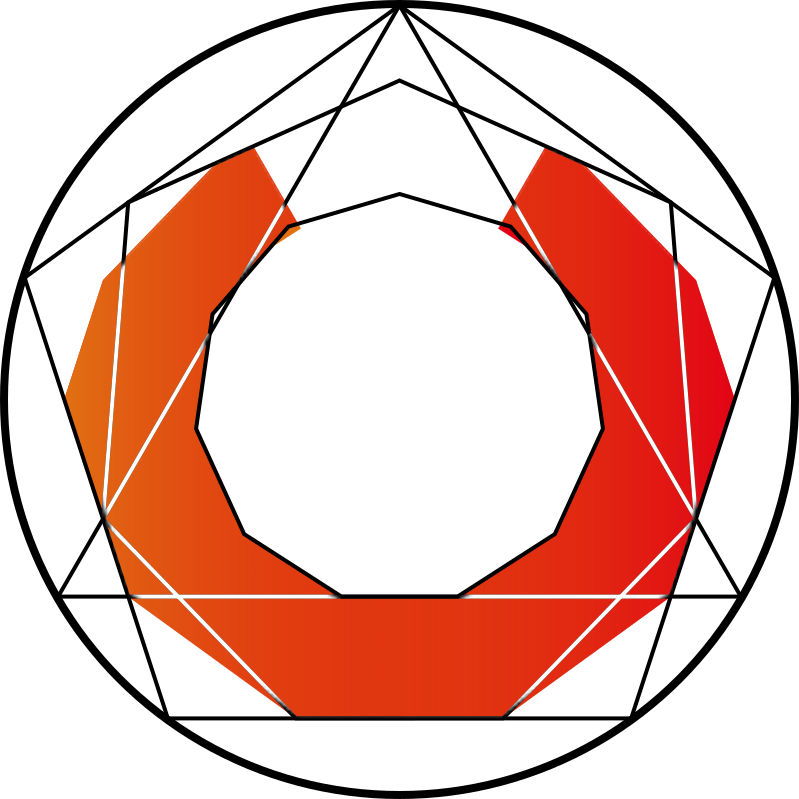
12-Tone Equal Temperament (12TET)
Historical context
12-Tone Equal Temperament (12TET) divides the octave into exactly 12 logarithmically equal steps, with each semitone being exactly 100 cents.
Historically, 12TET was developed as the ultimate compromise to the “comma drift” problem found in Just Intonation and meantone temperaments. While early theorists like Zhu Zaiyu in China (1584) and Simon Stevin in Europe mathematically defined equal temperament, it didn’t become the global standard until the late 19th and early 20th centuries.
By making every semitone identically sized, 12TET allowed keyboard instruments to modulate freely into any of the 12 keys without encountering a “Wolf Fifth” or requiring retuning. The trade-off was that no interval (other than the octave) is acoustically pure. The perfect fifth is slightly flat (~2 cents), which is barely noticeable, but the major third is severely sharp (~14 cents) compared to pure 5-limit Just Intonation, giving 12TET a distinctively bright, restless sound.
Role in Prime Period Theory
In Prime Period Theory (PPT), 12TET serves as the anchor grid or the “coarse resolution” layer.
PPT acknowledges that 12TET is the dominant acoustic environment of the modern world. Western functional harmony, the layout of the piano keyboard, and the frets on a guitar are all deeply tethered to this 12-note geometric structure. However, PPT treats 12TET not as a ceiling, but as a foundational coordinate system:
- The Uniform Solfège Anchor: The core 12-tone layer of Uniform Solfège (the base-12 notation system) maps directly onto 12TET. The solfège syllables (Do, Di, Re, Ri, etc.) act as the primary coordinate addresses.
- A 3-Limit Approximation: 12TET is fundamentally a 3-limit tuning system masquerading as a 5-limit one. Its fifths are excellent, making it a highly structurally stable grid for 3-prime (Pythagorean) geometry.
- The Diacritic Base: When exploring higher prime families (like the 5, 7, and 11-limits), PPT does not abandon the 12-tone grid. Instead, it treats 12TET as the “Base” state (0 cents of deviation) and uses the Prime Period Diacritic system (Sub, HalfSub, HalfSup, Sup, Axis) to explicitly measure how far a pure interval deviates from its nearest 12TET anchor.
- Absolute Pitch-Class Layer (Tri Notation): The 12TET partition into 7 natural notes and 5 accidentals allows each accidental to pair with a unique natural tritone partner, establishing Tri Pitch-Class Notation as a closed, unambiguous letter-naming layer for absolute pitches on the 12-tone grid.
By framing 12TET as a coarse scaffolding rather than a rigid cage, PPT allows musicians to navigate complex microtonal and just-intonation spaces while retaining the familiar landmarks of the 12-tone chromatic clock.
See also
- Tri Pitch-Class Notation — tritone-based absolute pitch-class naming for 12TET accidentals
- Uniform Solfège Overview — base-12 relational interval notation
- Prime Period Diacritics (PPD) — microtonal extensions tiling the 12TET grid
- 31 EDO — primary microtonal system with superior 5-limit thirds
- Chromatic Clock Geometry — geometric properties of the 12-tone circle
Knowledge Graph
status: stable