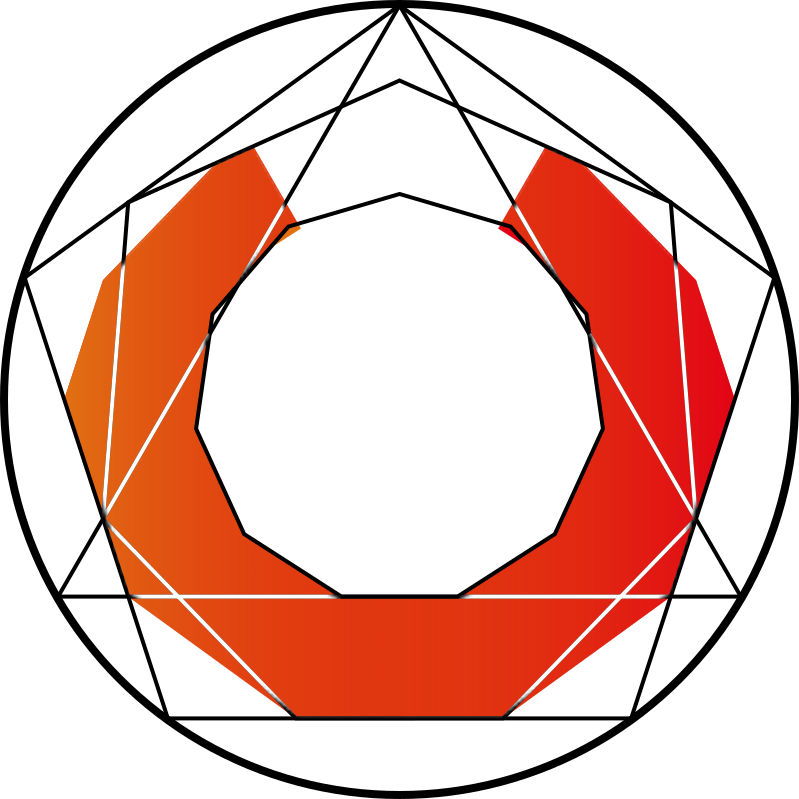
31 EDO
Historical context
Historically, 31 EDO’s development is deeply tied to the Renaissance and Baroque quest to solve the problems of meantone temperament.
In the 16th century, the shift towards triadic, 5-limit harmony (using pure major thirds) led to the adoption of meantone temperaments, particularly quarter-comma meantone. This tuning slightly flattened the perfect fifths so that four stacked fifths produced an exactly pure major third. However, this left a massive geometric gap at the end of the circle of fifths (the Wolf Fifth). To play in more keys, musicians needed more notes per octave.
In 1555, music theorist Nicola Vicentino designed the archicembalo, a keyboard instrument with 31 keys per octave, aiming to revive ancient Greek enharmonic and chromatic genera while providing pure major thirds across many keys. Later, in 1691, scientist Christiaan Huygens mathematically codified 31 EDO. He demonstrated that dividing the octave into 31 equal steps naturally produced a closed-cycle approximation of quarter-comma meantone temperament. In the 20th century, physicist Adriaan Fokker revived interest in the system, building a 31-tone organ and developing extensive theory around its harmonic properties.
Scale Building and Intervals in 31 EDO
31 EDO is generated by stacking fifths, much like 12TET, but its fifths are slightly flatter. A single step in 31 EDO is approximately 38.71 cents. Because the octave is divided into 31 parts, the “whole step” is composed of 5 units (diezes), and the diatonic semitone is 3 units, while the chromatic semitone is 2 units. This creates a clear distinction between enharmonic notes (e.g., C# and Db are different pitches in 31 EDO, with C# being lower than Db).
Role in Prime Period Theory
Within Prime Period Theory (PPT), 31 EDO is designated as the primary microtonal system. It bridges the gap between the familiar 12TET landscape and the pure geometries of Just Intonation.
31 EDO holds this privileged position in PPT for several structural reasons:
- 5-limit excellence: It provides nearly pure major thirds (deviating by less than a cent from the pure 5:4 ratio) and excellent minor thirds, making it a superior environment for 5-prime relationships compared to 12TET.
- 7-limit representation: It contains a highly accurate harmonic seventh (the 7:4 ratio is represented within ~1 cent of accuracy), unlocking the 7-prime family without requiring an unwieldy number of pitches per octave.
- 11-limit utility: While not perfectly pure, it contains useful approximations of 11-limit neutral intervals (like the neutral third and neutral seventh), functioning as the threshold of the PPT auditory horizon.
- Meantone properties: Because it is a meantone temperament, it preserves the syntonic comma (the difference between four perfect fifths and a major third is eliminated), making its chordal spellings structurally familiar to musicians accustomed to Western functional harmony.
In PPT, 31 EDO serves as the practical, playable grid for composers and performers who wish to explore the 5-prime and 7-prime families with far greater geometric fidelity than 12TET allows, while remaining within a manageable, cyclic equal temperament that can be played on keyboards and fretted instruments.
Knowledge Graph
status: stable