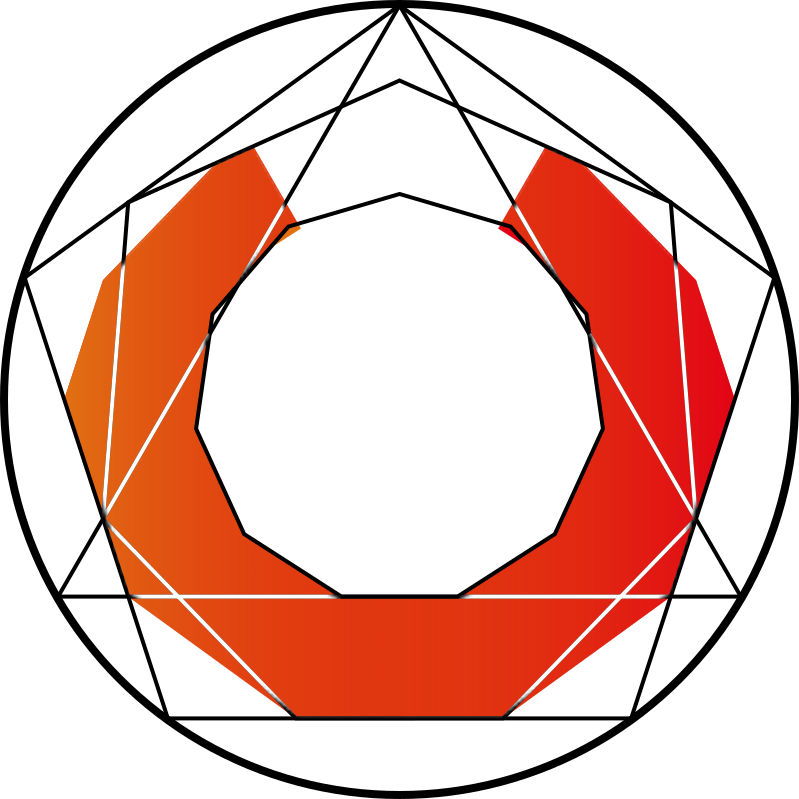
Pentatonic and Heptatonic Structures
Historical and cultural context
The pentatonic (5-note) and heptatonic (7-note) scales are the most ubiquitous melodic structures in human history. From ancient Chinese guqins and West African koras to Celtic folk songs and Western classical music, these specific groupings of pitches appear independently across isolated cultures worldwide.
This universality is not an accident of culture, but a direct consequence of acoustic geometry and the harmonic series—specifically, the 3-limit (the prime family of the perfect fifth, or 3:2 ratio).
Geometric Generation (The Stack of Fifths)
In Prime Period Theory (PPT), tuning systems and scales are not arbitrary collections of notes, but structures generated by prime-ratio intervals.
If you begin with a fundamental pitch and iteratively stack pure 3:2 perfect fifths, the geometric structure naturally “clumps” into distinct, highly stable scale forms before the intervals begin clashing:
-
The Pentatonic Scale (5 notes): Stacking four perfect fifths (e.g., C - G - D - A - E) and collapsing them into a single octave creates the major pentatonic scale. This structure has no semitones (no half-steps), meaning it lacks highly dissonant intervals like the minor second or tritone. This makes the pentatonic scale acoustically “safe” and deeply resonant, explaining its widespread use in folk music globally.
-
The Heptatonic Diatonic Scale (7 notes): Continuing the stack for two more fifths (e.g., F - C - G - D - A - E - B) yields the 7-note diatonic scale (the white keys of the piano). This introduces two semitones (E-F and B-C) and one tritone (F-B). These new, more “tense” intervals provide the structural gravity necessary for functional harmony and leading-tone resolutions.
-
The Chromatic Scale (12 notes): Stacking fifths until the cycle roughly closes (12 notes) generates the full chromatic scale, which is the foundational grid for 12TET and Uniform Solfège.
Role in Prime Period Theory
In PPT, Pentatonic and Heptatonic scales are not treated merely as “modes” or “keys,” but as geometric subsets of the 3-limit.
They represent different resolutions of the same underlying periodic structure. When analysing a melody, PPT views the shift from a pentatonic vocabulary to a heptatonic one as an increase in geometric complexity and harmonic tension. The pentatonic scale provides an open, stable 3-prime scaffold, while the heptatonic scale introduces the structural friction required to drive a phrase forward.
Because these scales are generated purely by the 3-limit, they exist independently of any specific temperament. They can be tuned in Just Intonation, 12TET, or 31 EDO, but their underlying geometric shape—a contiguous chain of fifths—remains identical.
See also
- Tetrachord-Pair Generation of Heptatonic Scales — a complementary generative method building heptatonic scales from two three-interval fragments and a join interval, reaching scales (harmonic minor, melodic minor, double harmonic) that fifth-stacking alone does not
- Just Intonation — the ratio-based tuning context for realising these scales
- Uniform Solfège — Overview — the interval syllable system used to name tetrachord and join intervals
Knowledge Graph
status: stable