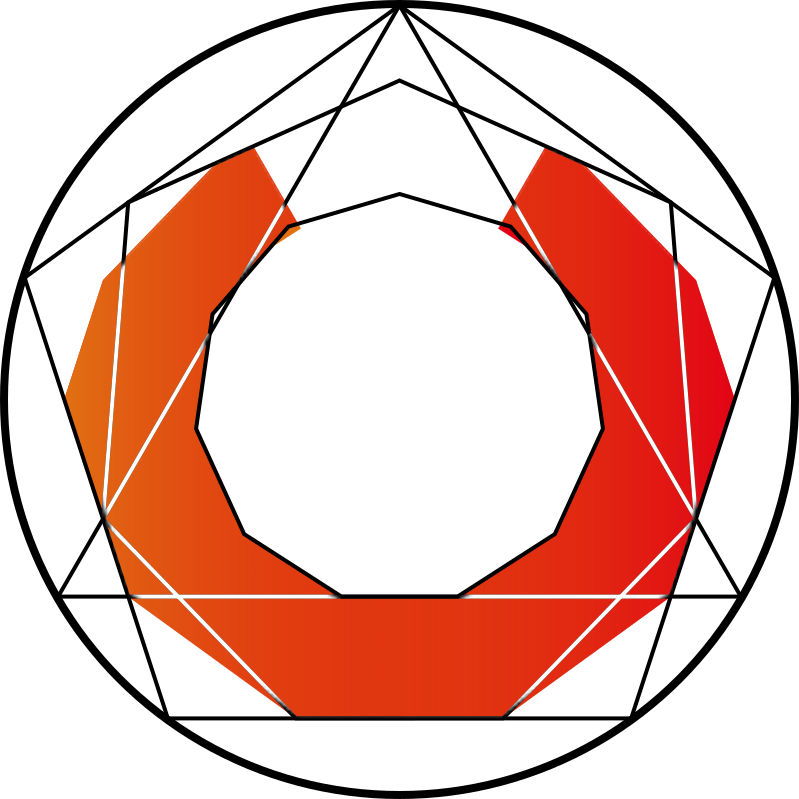
Core Tenets of Prime Period Theory
These five tenets are the philosophical and methodological commitments that underpin Prime Period Theory. They are intended to serve two purposes: as internal design principles that guide the continued development of the framework, and as a public statement of intent for anyone seeking to understand what kind of project PPT is and why it makes the choices it does.
1. Music is relational — information lives in relationships, not positions
A note has no musical meaning in isolation. Neither does a beat, a dynamic, or a duration. Musical information exists entirely in the relationships between points — the distance between pitches, the ratio between durations, the contrast between loud and soft. It is not the position of a note but its relationship to others that defines musical shape; not the speed of a beat but its ratio to the pulse around it. PPT treats these relationships — expressed as periodic ratios across time — as its fundamental object of study.
2. Prime families are the atoms of periodic structure
Primes are the irreducible units from which all periodic relationships are composed — through multiplication, exponentiation, and subdivision. Each prime family carries a characteristic perceptual quality that propagates through every ratio it generates. To internalise the feel of a prime family is to gain interpretive leverage over all the relationships built from it: understanding the character of 3 illuminates not just the perfect fifth but every ratio in which 3 appears as a factor.
3. The physical-biological system defines the scope
PPT is grounded in the intersection of acoustic physics and human biology — the conditions under which periodic structure can be produced and received as music. These boundaries are not arbitrary; they are the natural limits of the medium. But they are conditional: if the physical environment or biological substrate were to change, the analysis would need to follow. The framework makes no claim to transcend the physical system it describes.
4. First principles over inherited convention
PPT seeks to work at the layer beneath cultural and historical musical systems — the physical and biological constants that all traditions are built on top of. This is a direction of travel, not a completed achievement. Cultural systems are not dismissed; they are understood as particular implementations of more universal structures. Where cultural bias inevitably enters the framework, the goal is to name it explicitly and push further toward the more objective account.
5. The right abstraction enables meaningful decisions
Strong musical decisions come from understanding the simplest structure that still carries musical meaning — not from working with more information, but from working with the right information. PPT aims to strip away notation conventions, tuning compromises, and cultural assumptions to find the underlying structure that is both physically grounded and musically actionable. That is the level where analysis and creation become genuinely powerful. By stabilising the centre of any periodic continuum with a geometric, irrational midpoint (square root of 2) while mapping its internal contents via an 11-limit prime lattice, the framework provides a scale-invariant grammar that unifies the atom (pitch) and the galaxy (macro-form) of musical time.
See also
- Amplitude and Time — the physical basis for treating pitch and rhythm as one phenomenon
- Prime Families — the five prime generators and their perceptual characters
- Temporal-Place Limen — the physical-biological boundary between pitch and rhythm
- Music as Language — PPT as shared grammar and vocabulary for auditory classification
Knowledge Graph
status: stable