Prime Families
Why primes
Every ratio relationship between two periods can be decomposed into prime factors. Primes are the irreducible generators of that decomposition — they cannot themselves be built from smaller ratio relationships. This is the basis for using primes, rather than ratios in general, as the classification system for Periodicity:
Ratios tell you the relationship. Primes tell you the family.
3/2 and 9/8 are both ratios, but knowing they are both 3-prime — both generated purely from powers of the prime 3 — tells you something a bare ratio does not: that they belong to the same generative family, just at different distances from the origin. 9/8 is two stacked fifths (3² ⁄ 2³, octave-reduced); its character is an extension of the fifth’s world, not a new one.
Prime and exponent are different kinds of distance
A two-dimensional structure falls out of this naturally:
- Different primes = a genuinely new family, a new perceptual colour
- Higher powers of the same prime = still the same family, just further from the origin within it
In rhythm: 4/4 (2²) and 8/8 (2³) feel related — both purely 2-prime, just more finely subdivided. But 3/4 feels like a genuine change of world from 4/4, because it crosses into the 3-prime family entirely.
In pitch: the octave (2/1), the fifth (3/2), and the major third (5/4) each introduce a new prime and a genuinely new harmonic colour. The major ninth (9/8 = 3²/2³) is still 3-prime — an extension of the fifth, not a new family.
The five families
PPT works with five prime families, generated by the primes 2, 3, 5, 7, and 11. Each has a recognisable character at both the rhythmic (macro) and pitch (micro) scale:
| Prime | Rhythmic character | Pitch character | Cross-cultural presence |
|---|---|---|---|
| 2 | Duple — binary subdivision | Octave equivalence | Universal |
| 3 | Triple — swing, compound metre | Fifths, fourths (Pythagorean) | Universal |
| 5 | Quintuple — first “outside” layer | Major/minor thirds (Ptolemaic) | Common practice, Indian |
| 7 | Septuple — Balkan, Carnatic | Harmonic seventh, blue notes | Blues, Carnatic, barbershop |
| 11 | Rare, Messiaen-adjacent | Neutral intervals | Arabic maqam, some Indian raga |
The rhythmic and pitch columns are not loosely analogous — they are the same prime-generated structure, expressed at different timescales, exactly as established in Periodicity.
Why the classification stops at 11
PPT treats the 11-limit as a natural and principled ceiling, not an arbitrary one. The boundary is perceptual: 2, 3, 5, 7, and 11 each produce intervals that trained and untrained listeners alike can reliably distinguish as intentional, characterful pitch or rhythm relationships — not as out-of-tune or accidental deviations from a nearby simpler interval. The 13-limit and beyond is where this perceptual distinctness becomes genuinely contested, even among specialists in microtonal and just intonation theory. Extending the family system past 11 would add mathematical completeness without adding musically actionable vocabulary — the opposite of what a descriptive framework intended for working musicians should do.
The boundary is fundamentally asymptotic yet functionally bounded. As prime numbers scale higher, their corresponding intervals become more tightly packed on an infinite lattice, and the human brain’s coincidence-detection engine ceases to track them as discrete, functional “identities”. Instead, the ear begins to perceive intervals beyond the 11-limit merely as out-of-tune variations of lower-limit anchors or as continuous, unmappable space. Stopping the rational classification at 11 captures roughly 99.9% of human categorical auditory limits for deliberate musical vocabulary. Any remaining geometric discrepancies are cleanly reallocated to the irrational axis (square root of 2) or handled via the algebraic remainder system.
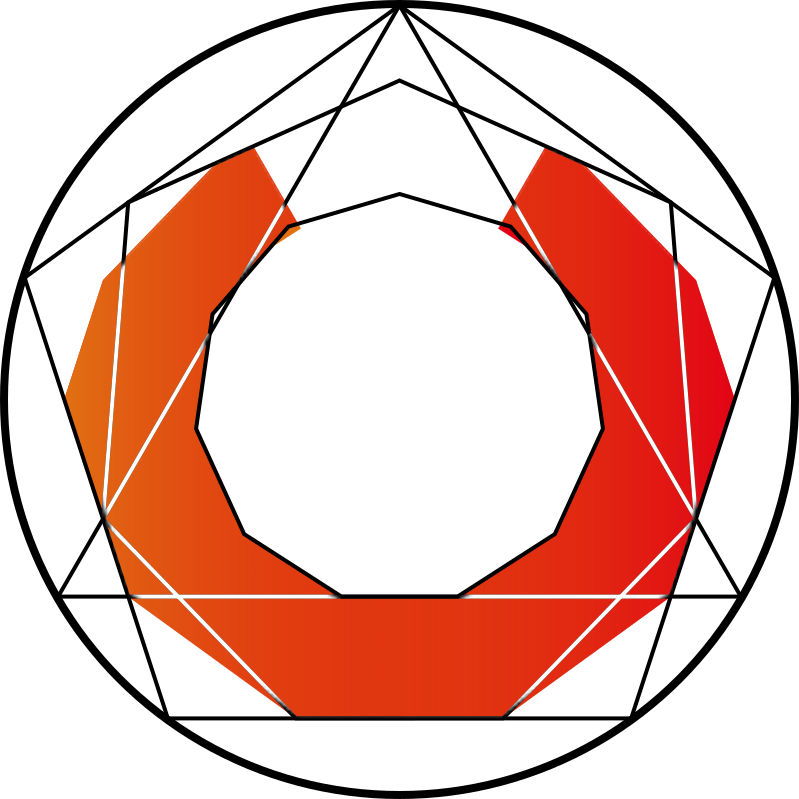
Stopping at 11 also keeps the system at a manageable five families — elegant both as a teaching structure and as the basis for Uniform Solfège’s geometric character set, which encodes each family as a distinct nested geometric form.
This ceiling applies to PPT’s description of intentional musical vocabulary — the pitches, intervals, and rhythmic subdivisions that a musician can reliably produce and a listener can perceive as deliberate rather than accidental. For spectral and timbral analysis of real instrument sounds, partials extend well beyond the 11-limit (13th, 17th, 19th partials and above are physically present and analytically significant). PPT provides a useful partial description of the lowest- prime partials in a spectrum, but does not attempt to be a complete timbral analysis system. For full spectral work, dedicated spectral analysis frameworks are the appropriate tool. PPT is intentionally scoped.
Interference and combination across families
When two periodic signals from the same prime family interfere — for instance, a 4/4 pattern layered against an 8/8 subdivision, or a fifth stacked on another fifth — the resulting interference pattern is itself periodic and resolves quickly, because both signals already share a common generator.
When two signals from different prime families interfere — a 3-against-2 polyrhythm, or a 7-limit harmonic seventh sounded against a 5-limit major third — the interference pattern takes longer to resolve to a shared period, and is perceived as more complex, more tense, or more colourful, depending on context. This is the same phenomenon described in Periodicity under “consonance as coincidence of periods”, now organised by which specific families are interacting.
This gives prime-family combination real descriptive power: knowing which two (or more) families are sounding together predicts, in general terms, how quickly and how simply the combination will resolve — whether the “combination” in question is a chord, a polyrhythm, or a blended timbre.
Timbre as prime-family composition
An instrument’s characteristic timbre can be described as its distribution of amplitude across the prime families present in its overtone series. An instrument rich in odd harmonics (3-prime and 5-prime partials, such as a clarinet) sounds categorically different from one dominated by even harmonics (2-prime and 5-prime partials, closer to a flute’s near-pure fundamental). The 7th partial, when present with any prominence, introduces the 7-prime family directly into the timbre and is heard as the characteristic “blue” or “earthy” colouration found in instruments and playing techniques associated with blues and barbershop voicing.
See Timbre for the full development.
Diacritics as prime-family subdivision
The prime families are also the geometric and conceptual foundation for Prime Period Diacritics (PPD). Each prime family maps to a distinct diacritic family used to mark fractional subdivisions between base periods, whether applied to pitch (as in Uniform Solfège), rhythmic duration, or other parameters.
See also
- Periodicity — the underlying unifying phenomenon
- Period — the bounded-space object that prime-family ratio relationships operate within
- Amplitude and Time — the physical grounding
- Uniform Solfège — Geometric Basis — how the five families are encoded as nested geometric forms
- Just Intonation — prime limits as pure ratios
- Rhythm and Pitch — domain-level detail