Geometric Basis
Why geometry, not just glyphs
Most notation systems use symbols by arbitrary convention — the symbol for a pitch is agreed upon, not derived. Uniform Solfège instead derives its character set from explicit geometric construction on the chromatic circle, so that reading the symbol is simultaneously reading the underlying interval geometry. This is a different pedagogical mechanism from convention-based notation: a student who spends time writing and reading the symbols absorbs the geometry of prime-family relationships through the act of using the notation, without needing to separately memorise a rulebook.
This page documents the specific geometric construction — both as the basis for the character set and as the basis for the Prime Period Theory mark (logo) itself, which were developed from the same underlying geometry.
The base construction: one circle per prime family
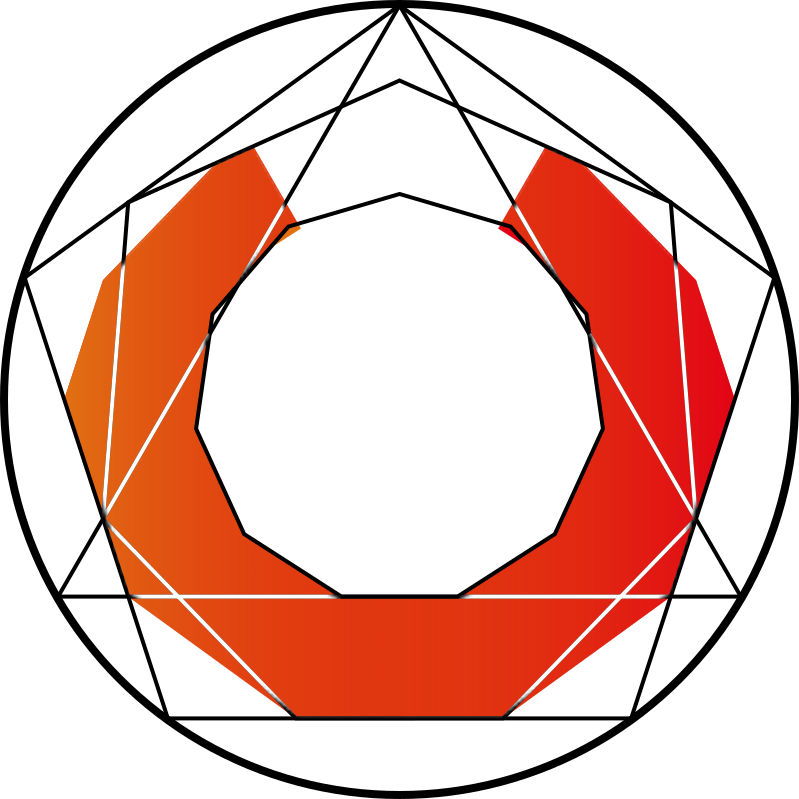
Each of the five prime families is represented by a shape inscribed on its own concentric circle, all sharing a common centre:
- 2-prime — the outermost circle itself. The circle, rather than a polygon, represents 2-prime because the octave (2/1) is what makes the pitch space circular in the first place — octave equivalence collapses an infinite line of pitches into a loop. The container is the 2-prime relationship, not a shape sitting inside it.
- 3-prime — an equilateral triangle, inscribed on the outer circle.
- 5-prime — a regular pentagon, inscribed on the same outer circle, sharing its apex vertex with the triangle.
- 7-prime — an irregular, mirror-symmetric heptagon, constructed on its own smaller circle nested inside the triangle/pentagon figure.
- 11-prime — a near-regular hendecagon (11-sided figure), nested inside the heptagon, small enough to be visually indistinguishable from a plain circle at most sizes.
This nesting is not arbitrary. For regular polygons sharing one circumradius, more sides means the polygon’s edges sit closer to the circle (the apothem grows with side count). A triangle’s edges cut in to 50% of the radius; a pentagon’s to 81%; a heptagon’s to 90%; an 11-gon’s to 96%. The result is that higher prime families naturally nest more closely against the circle — the 11-prime family, the most subtle and least commonly used, is correctly the family that is hardest to visually distinguish from the 2-prime circle itself, echoing its status as the most perceptually marginal of the five families admitted into PPT (see Prime Families for the reasoning behind the 11-limit ceiling).
Triangle and pentagon: a shared apex
The triangle (3-prime) and pentagon (5-prime) are both drawn point-up, sharing the same apex vertex on the outer circle. This shared apex is the construction’s anchor point — both shapes are referenced from a single origin direction, rather than independently rotated.
The heptagon: constructed from pentagon edges, not regular
A regular heptagon does not arise naturally from the triangle/pentagon overlay — direct intersection of a triangle and pentagon only ever produces five or six points, never seven, regardless of relative rotation. The heptagon is instead constructed deliberately, using the pentagon’s own edges as alignment guides:
- The heptagon’s base (its lowest mirrored vertex pair) is set to lie along the pentagon’s own base edge.
- The next vertex pair up on each side is solved to fall exactly on the pentagon’s upper edges (the two edges adjacent to the shared apex).
- The remaining vertex pair, and the top vertex, are positioned at regular angular spacing but with radii interpolated from the solved pairs.
The result is a heptagon with mirror symmetry only — left-right reflectional symmetry about the vertical axis — but not full rotational regularity. Its side lengths are not equal. This irregularity is intentional and meaningful: 7 is not a Fermat prime, and does not tile or resolve as cleanly against 12-based or 5-based structure as 3 and 5 do. An irregular heptagon, constructed from — but not equal to — the regularity of its neighbouring families, is a visually honest representation of that fact.
The 11-gon: comma-perturbed near-circle
The innermost figure, representing 11-prime, is built as a near-regular 11-sided polygon. Its vertices are perturbed from a perfectly regular hendecagon by a small amount tied directly to the Pythagorean comma — the ratio by which twelve justly-tuned fifths overshoot seven octaves, approximately 1.36%:
comma = (3/2)^12 / 2^7 − 1 ≈ 0.01364This perturbation is applied as a small radius modulation per vertex, rather than as an arbitrary irregularity. The result is a shape that reads as a plain circle at small sizes or from a distance, and only reveals its asymmetry on close inspection — a literal visual encoding of the comma itself: a discrepancy so small it is inaudible in most contexts, but real and structurally present once you look closely enough. This mirrors the 11-prime family’s role in PPT generally: the most subtle of the five admitted families, perceptible only with attention.
Fractal reading
Because each tier of the construction (circle → triangle/pentagon → heptagon → 11-gon) uses the same underlying logic — a shape constructed with reference to the shapes outside it, nested on its own circle — zooming into the innermost 11-gon and re-running the same construction process at that smaller scale would, in principle, reveal another nested set of prime-family shapes. The construction does not formally repeat at smaller scales in the current mark, but the reading of the figure as a fractal — zoom in, find another layer — is a deliberate and accurate way to view it, consistent with the self-similarity across scales that is foundational to PPT generally.
The emergent Do glyph
One property of this construction was not designed in advance but emerged from it, and was kept because it is genuinely meaningful: scaling the 11-gon outward until its lowest extent just touches the triangle’s base edge, then taking the overlap region of the 11-gon and the triangle, produces a shape that is rounded across the top and sides but flattened along the bottom — a cup or “U” profile. This matches the existing hand-drawn glyph for Do in the Uniform Solfège character set (see Diacritic System for the base character set this glyph belongs to).
This is treated as a meaningful coincidence rather than an engineered outcome: the same geometric logic used to encode the prime families independently produces the system’s own notation for the tonic, the anchor point of the whole notation system. It is not used as justification for the construction, but it is recorded here because it reinforces that the geometry is doing real representational work, not just decorative arrangement.
Relationship to the Prime Period Theory mark
This construction is also the basis for the PPT project mark (logo). The full version — outer circle, triangle, pentagon, heptagon, and 11-gon all visible together — serves as the construction diagram and full mark. A minimal version uses only the outer circle and the filled Do-glyph overlap shape, suitable for a favicon or small-scale use.
See also
- Diacritic System — the six-state microtonal extension built on top of the base character set
- Uniform Solfège Overview — the notation system as a whole
- Prime Families — the classification this geometry represents
- Periodicity — the underlying phenomenon the five families organise