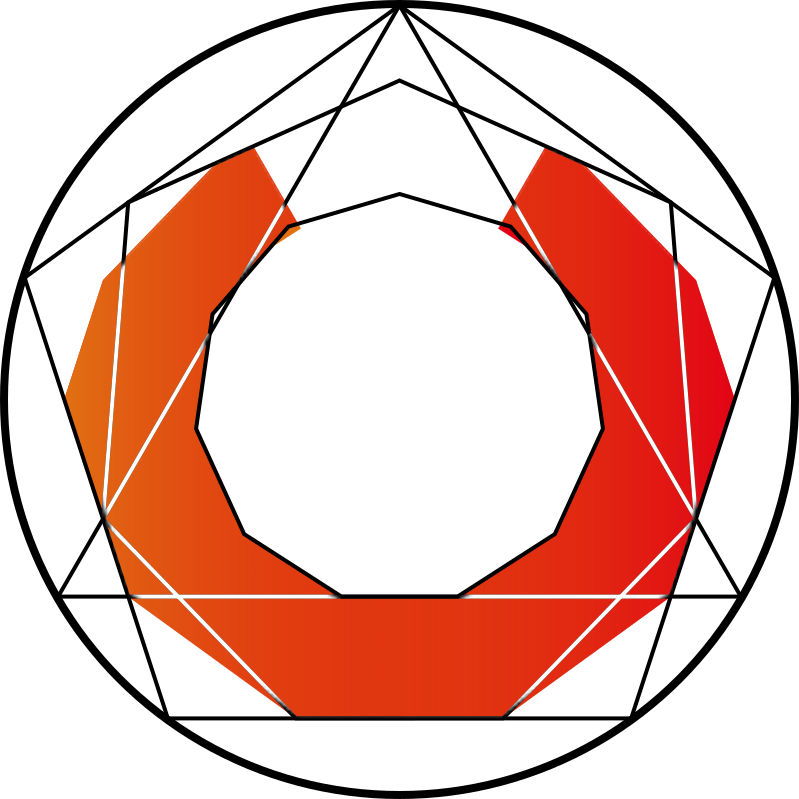
Diacritic System
Note: The diacritic system described here is an application of Prime Period Diacritics (PPD) to Uniform Solfège pitch space. Refer to PPD for the general specification; this document covers Uniform Solfège-specific mappings only.
The diacritic system as writing system
The six-state diacritic model (Sub, HalfSub, Base, HalfSup, Sup, Axis) is a writing system approximation of the prime lattice comma space. It provides a practical, finite set of visually distinct glyph states that cover the most musically useful positions in that space, rendered within the constraints of a handwritten or typeset notation system.
The mathematical object being approximated is an ordered comma sequence
— an array of { prime, step } entries in the
prime lattice. The diacritic glyph
is a rendered representation of that sequence at a chosen level of
precision, in the same way that a decimal number is a rendered
representation of a real-number value at a chosen number of significant
figures.
The six states are not the definition of the microtonal space. They are a practical rendering of the most commonly needed positions in that space. Less common positions — deeper fractal subdivisions in odd primes, or higher Sep or Undec magnitudes — can be described in the comma system precisely while the writing system renders them at the nearest practical glyph form.
Crucially, there is an intentional gap between this writing representation (which currently supports 1-level descent across odd primes, and a fractal descent only in Du prime space up to depth 4, akin to a rhythmic bitmask) and the underlying mathematics (which allows unlimited fractal descent across all primes). This gap will be resolved as the system evolves, but the diacritic glyphs remain finite approximations.
This framing separates two concerns that the diacritic system has historically carried together:
- The mathematical layer: what position in the prime lattice is intended. This is captured precisely by the comma sequence.
- The writing layer: how that position is rendered in notation. This is captured by the PPD glyph form.
Both layers are necessary. The writing layer makes the notation readable and writable by humans; the mathematical layer makes it precise and machine-processable.
Overview
The Uniform Solfège diacritic system encodes sub-semitone pitch positions by applying Prime Period Diacritics (PPD) to the base chromatic solfège glyphs. Each diacritic family corresponds to a prime number and subdivides the chromatic semitone (100¢) into exact rational intervals — no decimal approximation, no rounding.
The system is built on the PPD families: Du (Axis), DuTri, Tri, Qui, Sep, and Undec. It comprises two functionally distinct groups:
- Approximation family: Du (prime 2), including Fractal Du — a recursive binary subdivision system
- Exact families: Tri, Qui, Sep, UnDec (primes 3, 5, 7, 11) — fixed rational targets
These two families are structurally and semantically separate and should not be conflated.
The Tritone Axis and 11-Limit Convergence
The tritone position (Fi, position 6) is structurally unique in the system. While the 11-limit prime family natively yields an over-tritone (11:8) and an under-tritone (16:11), Uniform Solfège intentionally collapses this neighborhood into a single cardinal position mapped to the irrational geometric mean (square root of 2 over 1).
This hybrid design delivers a “closed” geometric axis of symmetry for multi-domain base-12 algebra while gracefully acting as a structural proxy for the 11-limit tritone family. When strict acoustic realism or specific prime-limit alignments are required, the system utilizes the Undecimal diacritics as rational offsets from this geometric centre:
- FiUnDecSub1 (or a customised Sub-inflection): Pulls the square root of 2 axis downward to approximate the pure acoustic resonance of the lesser-tritone (11:8).
- FiUnDecSup1 (or a customised Sup-inflection): Pushes the square root of 2 axis upward to approximate the pure acoustic resonance of the greater-tritone (16:11).
Note on “Axis” across contexts: The term Axis is used in three distinct ways within the PPT framework. (1) Topologically, it is the prime-agnostic shared upper boundary (+50%) between adjacent periods. It is not a separate prime family, but rather Du’s own coarsest-frame digit (
±1/2). (2) As the Du-family glyph: the horizontal crossbar at 50% of the period. Because Du’s recursive bisection lands exactly on this boundary at its first step, the boundary itself is often visually associated with Du, but its topological role is universal. (3) In Rhythmic Grammar: the Axis suffix on Do and Di (written Dox, Dix) marks rhythmic block boundaries. The three uses are contextually distinct and do not overlap.
Romanized Notation Standard
To ensure machine parsability and consistent written communication, Uniform Solfège uses a standardized romanized string format to represent syllables, diacritics, and superscripts.
A full solfège token is constructed as a single continuous string without spaces, following these rules:
- Base Solfège: Must be exactly two characters in title case (
[A-Z][a-z]), matching the twelve base chromatic syllables (e.g.,Do,Re,Fi). - Diacritic Suffix: If a diacritic is applied, it immediately follows the base syllable in title case. The standard suffixes are:
Sub: period compression (negative Tri)HalfSub: period compression (negative DuTri)HalfSup: period expansion (positive DuTri)Sup: period expansion (positive Tri)Axis: The 50¢ Du boundaryx: A convenient shorthand forAxis(e.g.,Doxis exactly equivalent toDoAxis)
- Superscript Concatenation: Superscripts (used for remainder sub-glyphs or cross-family notation) are concatenated using the caret (
^) symbol. The string following the caret is parsed as its own complete solfège token.
Examples:
Do— Base chromatic syllable (Base declaration; path length zero, peranchors.md)ReSub— Re with a negative Tri diacritic (period compression)DoxorDoAxis— Do with the Axis diacritic (Du digit+1at the coarsest open frame)Dox^ReSub— Do with the Axis diacritic, hosting a superscript ofReSub
Note on Diacritic Scope Limitations: While the underlying mathematical model supports a neighbour-frame reading of the edge (e.g., the previous anchor’s supremum) and complex interior fractal descent past it, the diacritic writing system explicitly does not currently represent the neighbour-frame reading of the edge, nor interior fractal descent past it. This is a scope limitation of the glyph set, not of the underlying math.
Reference Interval
All diacritics operate within a single chromatic semitone. The reference interval is 100¢ (one semitone), consistent across all prime families. The base solfège syllables (Do, Di, Re, Ri, Me, Mi, Fi, Se, So, Si, La, Ti) are the shared zero-reference points — chromatic anchors common to all families.
Solfège Symbol Range
Each solfège symbol owns a 100¢ space. The boundary conditions are:
- Base (0¢): the exact chromatic anchor — undecorated glyph
- Axis (50¢): the midpoint between chromatic anchors — the terminal point of the solfège range and threshold of the Du approximation space
The full range of any solfège symbol runs from UnDecSub5 through to Axis (50¢). The widest negative reach of any diacritic is UnDecSub5 at −5/11 of the period (≈ −45.45%). This stays within the valid symbol range of (−50%, +50%] — the period boundary at −50% (the adjacent symbol’s Axis) is never crossed or reached. The opening direction of the UnDecSub5 moon glyph (toward the previous symbol’s Axis) is directionally honest: it signals proximity to −50%, the territory boundary, without crossing it.
Glyph Forms Summary
For the full visual specification of diacritic shapes, see PPD Glyph Forms. When applied to Uniform Solfège, these forms interact with the specific geometry of the solfège characters (the rotated U with decorated arms):
| Family | Forms | Uniform Solfège Specifics |
|---|---|---|
| Du (Axis) | Horizontal stroke | Passes through the vertical arms of the base character. Extended for Fractal Du to provide legibility clearance. |
| Tri / DuTri | Triangles | Attached at the base character perimeter. |
| Qui | Triangle + T-cross | Pointing away from the base character perimeter. |
| Sep | Ticks / capped strokes | Placed on the 3 o’clock side (positive) or 9 o’clock side (negative) of the base character. |
| Undec | Moons | Placed at the cardinal points (3 o’clock or 9 o’clock). |
Pitch Position Mappings
The following tables show how the PPD positions map specifically to cents from the Base chromatic anchor.
Du (Prime 2) — Approximation Family
Fractal Du subdivides the space between Base and Axis via binary halving.
| Depth | Shorthand | Position (¢) |
|---|---|---|
| 1 | Dox | 50¢ |
| 2 | Doxo / Doxi | 25¢ / 75¢ |
| 3 | Doxoo / Doxio | 12.5¢ / 62.5¢ |
Tri (Prime 3) — Exact Family
Tri provides six evenly-spaced positions per semitone, combining to tile the 72 EDO grid.
| Position | ¢ from Base | Accidental analogy |
|---|---|---|
| Sub | −33.33¢ | 𝄫 double flat |
| HalfSub | −16.67¢ | ♭ flat |
| Base | 0¢ | ♮ natural |
| HalfSup | +16.67¢ | ♯ sharp |
| Sup | +33.33¢ | 𝄪 double sharp |
| Axis | +50¢ | threshold |
Qui (Prime 5) — Exact Family
| Position | ¢ from Base |
|---|---|
| QuiSub2 / HalfQuiSub | −40¢ |
| QuiSub1 / QuiSub | −20¢ |
| Base | 0¢ |
| QuiSup1 / QuiSup | +20¢ |
| QuiSup2 / HalfQuiSup | +40¢ |
Sep (Prime 7) — Exact Family
| Position | ¢ from Base |
|---|---|
| SepSub3 / HalfSepSub | −42.86¢ |
| SepSub2 | −28.57¢ |
| SepSub1 / SepSub | −14.29¢ |
| Base | 0¢ |
| SepSup1 / SepSup | +14.29¢ |
| SepSup2 | +28.57¢ |
| SepSup3 / HalfSepSup | +42.86¢ |
UnDec (Prime 11) — Exact Family
| Position | ¢ from Base |
|---|---|
| UnDecSub5 | −90.91¢ |
| UnDecSub4 | −81.82¢ |
| UnDecSub3 | −72.73¢ |
| UnDecSub2 | −63.64¢ |
| UnDecSub1 | −54.55¢ |
| Base | 0¢ |
| UnDecSup1 | +9.09¢ |
| UnDecSup2 | +18.18¢ |
| UnDecSup3 | +27.27¢ |
| UnDecSup4 | +36.36¢ |
| UnDecSup5 | +45.45¢ |
Universal Grid and Remainder System
LCM Grid
The base grid is derived from the LCM of the exact prime family denominators: DuTri (÷6), Qui (÷5), Sep (÷7), and Undec (÷11). LCM(6, 5, 7, 11) = 2310 units per period. This grid is not per semitone specifically — it applies to any defined period: a solfège note’s range, an octave, a rhythmic cycle, a dynamic envelope. Du and Fractal Du sit outside this grid as an approximation family; each depth of Fractal Du doubles the grid resolution, extending 2310 to 4620 (depth 1), 9240 (depth 2), and so on.
The exact prime families and their period subdivisions are:
| Family | Subdivision |
|---|---|
| DuTri (compound of Tri + AxisTri) | ÷6 |
| Qui | ÷5 |
| Sep | ÷7 |
| Undec | ÷11 |
Each family’s step size on this grid:
| Family | Grid units per step |
|---|---|
| DuTri (÷6) | 385 |
| Qui (÷5) | 462 |
| Sep (÷7) | 330 |
| Undec (÷11) | 210 |
| Fractal Du depth | Total grid units per period |
|---|---|
| Depth 0 (exact families only) | 2310 |
| Depth 1 (Axis included, ÷2) | 4620 |
| Depth 2 (÷4) | 9240 |
| Depth 3 (÷8) | 18480 |
Cross-Family Arithmetic and Remainders
Within-family arithmetic is always closed and exact — n/p ± m/p = (n±m)/p, always the same prime family.
Cross-family arithmetic (e.g. a Qui point ± a Sep point) produces exact rationals on the 2310 grid (or 4620 at Fractal Du depth 1) but with denominators (e.g. 35, 55, 77) not covered by any single diacritic family. These residuals are PPT commas — irreducible gaps between prime families, exact and nameable.
Named commas identified:
- Sep/UnDec comma: 1/77 of the period (≈ 1.30¢ per semitone). Derived from the gap between SepSup2 (2/7) and UnDecSup3 (3/11): 2/7 − 3/11 = 1/77. — appears twice symmetrically around 50¢
- Sep/DuTri comma: 1/42 of the period (≈ 2.38¢ per semitone). Derived from the gap between SepSup1 (1/7) and DuTri HalfSup (1/6): 1/6 − 1/7 = 1/42.
Do as Remainder Register
Any cross-family arithmetic remainder is sub-semitone by definition, so it always fits within the diacritic space. Do (Base) is the canonical remainder register — remainders are expressed as Do-anchored sub-glyphs regardless of which chromatic syllable hosts the primary diacritic.
This gives a natural canonical form for any pitch:
- Base chromatic syllable — coarse position
- Prime family diacritic — fine position within semitone
- Do-anchored remainder sub-glyph — cross-family arithmetic residual (if needed)
The remainder sub-glyph occupies the descent zone of the host glyph (see Glyph Architecture). The Do-remainder is always a U-form (Do-oriented arc) since remainders are always Do-anchored — the descent zone is semantically typed, never ambiguous.
Poly-Base Structure
The diacritic families form a parallel multi-base coordinate system on the same pitch line, unified at the chromatic anchor points. Key properties:
- Bases are parallel, not hierarchical (unlike mixed-radix systems)
- Moduli (2, 3, 5, 7, 11) are coprime — unique reconstruction from residues (cf. Chinese Remainder Theorem)
- Chromatic anchors are the common zeros across all families
- Diacritics are mutually exclusive — each pitch carries one family’s diacritic only
This is not a tensor product or direct sum — it is a partition of rational pitch space by prime family, unified at the integers. No standard algebraic name exists for this structure; it is defined here as a foundational PPT construct.
Practical Coverage
- Perceptual layer: primary diacritics to ~6¢ (Fractal Du ÷16)
- Performance layer: Fractal Du ÷32 to ~3¢ — human-articulable in rhythm, audible in sustained pitch
- Algebraic layer: 2310-grid remainders for exact cross-family arithmetic
The system is perceptually complete at the diacritic layer, algebraically complete at the remainder layer, and theoretically open via decimal extension.
Applications
Pitch: honest representation of blue notes, just intonation chords, shruti positions, spectral partials — without approximation to 12-EDO. C# and D♭ are distinct pitches (BaseTri Sup and next-symbol BaseTri Sub) rather than collapsed into one equal-tempered slot.
Rhythm: prime family subdivision applies identically to rhythmic cycles. Tuplets in 5, 7, and 11 are first-class citizens. Polyrhythm across families (5 against 7) is Qui vs Sep subdivision of the same period. The Fractal Du bitmask maps directly onto standard beam notation — the isomorphism is explicit and teachable.
Interval analysis: any two pitches have exact rational distance. Cross-family intervals produce PPT commas as algebraic residues.
Timbre: harmonic partials are a prime-ratio structure. Spectral analysis uses the same coordinate system as pitch and rhythm.
Relationship to Tuning Systems
- 72-EDO: the six DuTri positions per semitone (÷6) exactly reproduce 72-EDO within the chromatic space. 72-EDO is an emergent property of the two interlocking Tri triangles, not a design target.
- 31-EDO: BaseTri Sub/Sup at ±33.33¢ approximate the 31-EDO enharmonic distinction (~38.71¢) with a gap of ~5.38¢ — a nameable PPT comma. 72-EDO provides a good approximation grid for 31-EDO but not an exact one.
Open Questions
- Formal naming and catalogue of all PPT commas derivable from cross-family arithmetic
- Decimal-place extension convention: notation for nested prime family diacritics as successive approximation digits
- FontForge implementation: GSUB lookup structure, GPOS axis-relative mark attachment anchors
- PUA codepoint block allocation for MusiCoil
See also: Geometric Basis for glyph architecture (three-zone structure, axis-relative remainder placement, rotational identity of the four arc families).
Knowledge Graph
status: stable