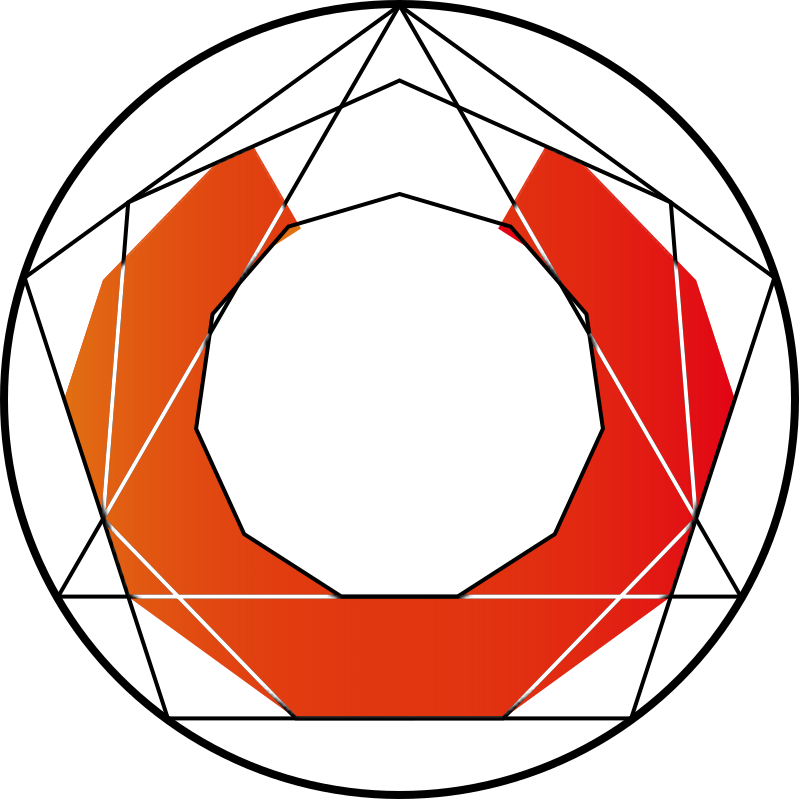
Tri Pitch-Class Notation
What it is
Tri pitch-class notation is an absolute pitch-class naming scheme for twelve-tone equal temperament (12TET). It assigns each of the five chromatic accidentals a single, unambiguous letter-name derived from its tritone relationship to a diatonic natural note.
       Tri-C (F#/Gb)
             ^
             |  (6 semitones)
             v
             C
Distinction from Uniform Solfège
It is important to distinguish Tri notation from Uniform Solfège:
- Uniform Solfège is a relative interval and scale-degree numeral system operating in base-12 (Do, Ra, Re, Me, Mi, Fa, Fi, So, Le, La, Te, Ti), describing relational distance from a moveable or fixed tonic.
- Tri Pitch-Class Notation is an absolute pitch-class naming layer using letter symbols. It identifies specific chromatic pitch classes without altering or replacing the functional degree system.
The two systems are complementary: Uniform Solfège calculates structural intervals across pitch, rhythm, and timbre, while Tri notation provides a concise, absolute pitch vocabulary when interacting with 12TET instruments and traditional letter-name contexts.
Core definition: The five Tri pairs
For any natural note X, Tri(X) names the pitch class exactly one tritone (6 semitones, or half an octave) above X.
The twelve chromatic pitches in 12TET divide into seven natural notes (white keys on a keyboard) and five accidentals (black keys). Every accidental possesses exactly one natural tritone partner, producing five canonical Tri pairs:
Natural Note (X) | Tri Pitch Name | Enharmonic Equivalent | Mod-12 Offset (X + 6) |
|---|---|---|---|
| C | Tri-C | F♯ / G♭ | 0 + 6 = 6 |
| D | Tri-D | G♯ / A♭ | 2 + 6 = 8 |
| E | Tri-E | A♯ / B♭ | 4 + 6 = 10 |
| G | Tri-G | C♯ / D♭ | 7 + 6 = 1 (13 mod 12) |
| A | Tri-A | D♯ / E♭ | 9 + 6 = 3 (15 mod 12) |
The B and F exclusion boundary
The natural notes B and F are excluded from the Tri naming scheme.
B and F are separated by 6 semitones and form the only natural-to-natural tritone pair within the diatonic collection — the historical diabolus in musica among the white notes. Because B and F are already both natural letter names, neither qualifies as an accidental, and neither takes a Tri prefix.
This exclusion is not an edge case; it is a foundational boundary condition of the 7+5 chromatic partition. As detailed below, this boundary recurs across scale-spelling mechanics and circle-of-fifths mnemonics.
Notation and pronunciation
Written form
In written notation, Tri pitch classes are represented by drawing a symmetrical triangle glyph around or above the natural letter (e.g. △A or an enclosed A within a triangle), matching playing-card iconography. Because equilateral and isosceles triangles can be drawn orientation-symmetrically, the symbol reads identically when rotated 180°.
Spoken form
In spoken usage, the prefix “Tri-” is simply prepended to the natural letter name:
Tri-C(“try-see”)Tri-D(“try-dee”)Tri-E(“try-ee”)Tri-G(“try-jee”)Tri-A(“try-ay”)
A dedicated phonetic marker (such as a dental-fricative prefix) was evaluated during development and rejected in favour of plain, clear pronunciation.
Relationship to sharps and flats
The central design principle of Tri notation is a clean separation of roles between pitch identity and functional voice leading:
- Sharps and flats are functional operators on natural letters. They modify a natural pitch while preserving its specific letter slot in a heptatonic scale. For instance, in G♭ major, the fourth scale degree is spelled C♭ (rather than B) because every heptatonic scale requires exactly one instance of each letter from A to G in sequence.
- Tri names are closed nouns. A Tri name designates a concrete pitch-class identity on equal footing with the natural letters A–G. Because there are exactly five Tri names mapping 1:1 to the five accidentals, there is no letter-slot redundancy, and therefore no structural need or allowance for stacking an accidental onto a Tri name.
Functional operator:   Natural Letter (C) + Flat (b)  -> Cb (preserves 4th degree slot in Gb major)
Closed noun:          Tri-E                           -> Absolute pitch class (A#/Bb)
Expressions such as “Tri-C-Sharp” are invalid in the syntax. While it is an algebraic curiosity that Tri(X) and a semitone shift commute under modulo-12 addition — meaning Tri(C#) and (Tri-C)# both evaluate to 7 (G) — stacking accidentals onto Tri names was discarded to keep the five accidental nouns closed and unambiguous.
Compact scale shorthand
Tri notation provides a compact single-character shorthand for transcribing scales and melodies using a lower-case t prefix:
- G Major:
G A B C D E tC(F♯ =Tri-C) - D Major:
D E tC G A B tG(F♯ =Tri-C, C♯ =Tri-G) - F Major:
F G A tE C D E(B♭ =Tri-E) - A Major:
A B tG D E tC tA(C♯ =Tri-G, F♯ =Tri-C, G♯ =Tri-D— wheretA= D♯/E♭,tG= C♯/D♭,tC= F♯)
Structural vs carried-over accidentals
When reading multi-accidental scales in Tri shorthand, an important structural distinction applies:
- In any major scale, scale degree 4 and scale degree 7 form the essential diatonic tritone that drives dominant-to-tonic resolution (the active tritone in the
V7chord). - In compact Tri spelling, only the final accidental introduced before the octave represents this structural 4th-to-7th tritone partner for that key.
- Any earlier accidental in the string is a carried-over key-signature accidental from preceding fifth-cycle steps, not a unique structural interval of that specific mode.
For example, in D Major (D E tC G A B tG), tG (C♯) is the leading tone forming the structural tritone with G (degree 4). The earlier tC (F♯) is a carried-over accidental from G Major.
Circle of fifths relationships
Mnemonic generation
Around the circle of fifths, Tri notation provides a direct algebraic mnemonic for key signature progression among natural keys:
-
Sharp-wise progression (+7 semitones): Moving up by a fifth from tonic
X, the newly introduced sharp accidental is alwaysTri(X)(the Tri name of the previous tonic).C Major→G Major: new accidental isTri-C(F♯).G Major→D Major: new accidental isTri-G(C♯).D Major→A Major: new accidental isTri-D(G♯).A Major→E Major: new accidental isTri-A(D♯).E Major→B Major: new accidental isTri-E(A♯).
Algebraic proof: In 12TET, the leading tone of key
(X + 7)is(X + 7 - 1) = (X + 6) mod 12. By definition,Tri(X) = (X + 6) mod 12. Thus,Tri(old tonic)identically computes the leading tone of the new fifth-step key. -
Flat-wise progression (-7 / +5 semitones): Moving down by a fifth to new tonic
Y, the newly introduced flat accidental is removed or identified viaTri(Y):C Major→F Major: new accidental isTri-E(B♭), the subdominant degree.
Breakdown at the B/F boundary
This mnemonic operates seamlessly across natural heptatonic roots but breaks at the B/F seam:
- When moving from
B MajortoF# Major, the newly raised seventh is spelledE#rather than a Tri-name, becauseFis already claimed as the letter name of the new tonic itself (F#). - This breakdown stems from the same structural boundary condition that excludes B and F from having Tri names.
Visual symmetry on the circle of fifths
When the circle of fifths is oriented with D at the top (12 o’clock) and its tritone partner Tri-D / A♭ at the bottom (6 o’clock):
                     D (12:00)
             G               A
         C                       E
      F                             B (3:00)  <-- B-F Mirror Axis
   Tri-E                           Tri-G
      Tri-A                     Tri-C
Tri-D / Ab (6:00)- Mirror symmetry across the B–F horizontal axis:
- Reflecting across the horizontal axis passing through B (3 o’clock) and F (9 o’clock) maps natural notes to natural notes (
D↔Tri-D,G↔Tri-A,C↔Tri-E,A↔Tri-C,E↔Tri-G) and accidentals to accidentals.
- Reflecting across the horizontal axis passing through B (3 o’clock) and F (9 o’clock) maps natural notes to natural notes (
- Antipodal (180° rotational) symmetry:
- Across any orientation, diametrically opposite notes on the circle of fifths are tritone pairs.
- Precision note: Mirror reflection across the B-F axis and 180° antipodal rotation are distinct geometric operations. Only the
D/Tri-Dpair simultaneously coincides under both transformations in this orientation.
See also
- Chromatic Clock Geometry — 12-tone circle geometry and tritone antipodal axes
- Tone Atlas — visual mapping of pitch relationships and subclock navigation
- 12-Tone Equal Temperament (12TET) — the 12-tone anchor grid
- Axis-Fan Pedagogy — tritone-first pedagogical harmony sequence
- Uniform Solfège Overview — base-12 relational interval notation
- Piano Triangle Notation — base-3 ergonomic keyboard notation
Knowledge Graph
status: draftdepends_on:contrasts_with: