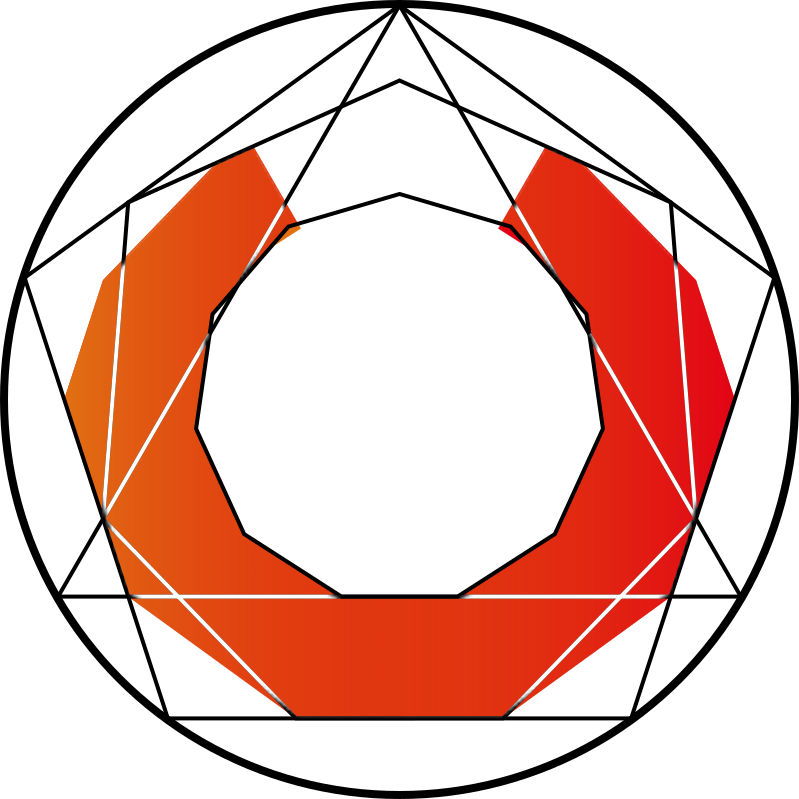
Rhythmic Overtone Series
The core claim
A pitched tone has a harmonic spectrum — a structured set of partial frequencies standing in integer ratios to a fundamental. Their amplitudes decrease as the partial number increases: the fundamental is loudest, the second partial (2:1) is next, the third (3:1) next, and so on. The prime complexity of the partials increases as their frequency of occurrence decreases.
A rhythmic phrase of n evenly spaced beats has an inter-onset ratio spectrum with the same structure — not approximately, not analogously, but as the same mathematical object expressed at a different timescale.
This is a direct consequence of Prime Period Theory’s core thesis: the Temporal-Place Limen is a perceptual boundary, not a structural one. The same mathematical relationships that generate the harmonic series at audio rates generate an equivalent structure at rhythmic rates.
Formal definition
Given a phrase of n evenly spaced beats, label each onset position 1, 2, 3, … n. For any two onset positions i and j where j > i, the inter-onset ratio at distance d = j − i is:
ratio(d) = d : 1 (inter-onset span of d beats relative to 1 beat)The full set of inter-onset ratios in a phrase is the collection of all such ratios for d = 1, 2, 3, … n−1.
The occurrence count of ratio d within a phrase of n beats is:
count(d, n) = n − dThat is: a distance of d=1 (adjacent beats) occurs n−1 times; a distance of d=2 occurs n−2 times; and so on. Larger distances are less frequent — exactly as higher partials are lower in amplitude in the harmonic series.
The rhythmic overtone spectrum of a phrase of n beats is therefore:
| Distance d | Ratio | Prime family | Occurrences in n-beat phrase |
|---|---|---|---|
| 1 | 1:1 | 2-prime (unison / 2-prime octave equivalence) | n − 1 |
| 2 | 2:1 | 2-prime | n − 2 |
| 3 | 3:1 | 3-prime | n − 3 |
| 4 | 4:1 | 2-prime (2²) | n − 4 |
| 5 | 5:1 | 5-prime | n − 5 |
| … | … | … | … |
| n−1 | (n−1):1 | Depends on n−1 | 1 |
The pattern is precise: prime complexity increases as occurrence frequency decreases. The most common relationship is the simplest (d=1, 2-prime); the least common is the most complex (d=n−1, depends on the prime factorisation of n−1).
Worked example: 4-beat phrase
Consider four evenly spaced beats: positions 1, 2, 3, 4.
All inter-onset pairs, grouped by distance:
Distance d = 1 (adjacent pairs: 1–2, 2–3, 3–4) — ratio 1:1 — 3 occurrences
●   ●   ●   ●
|→1→|   |   |
    |→1→|   |
        |→1→|
Distance d = 2 (pairs: 1–3, 2–4) — ratio 2:1 — 2 occurrences
●   ●   ●   ●
|——→2——→|   |
    |——→2——→|
Distance d = 3 (pair: 1–4) — ratio 3:1 — 1 occurrence
●   ●   ●   ●
|————→3————→|
Summary table:
| Distance | Ratio | Prime family | Count | Relative frequency |
|---|---|---|---|---|
| d = 1 | 1:1 | 2-prime | 3 | Most frequent |
| d = 2 | 2:1 | 2-prime | 2 | Less frequent |
| d = 3 | 3:1 | 3-prime | 1 | Least frequent |
This is structurally identical to the first three partials of the harmonic series: the fundamental (1:1), the first overtone (2:1), and the second overtone (3:1) — with amplitude decreasing as partial number increases, and prime complexity increasing as amplitude decreases.
The identity with the harmonic overtone series
In the harmonic series, the k-th partial stands in ratio k:1 to the fundamental, and its amplitude is (in the idealised case of a sawtooth wave) proportional to 1/k. The prime factorisation of k determines which prime family the partial belongs to.
In the rhythmic overtone series of a phrase of n beats:
- The d-th ratio class stands in ratio d:1 to the unit beat
- Its occurrence count is n − d, which decreases linearly as d increases
- The prime factorisation of d determines which prime family the ratio belongs to
The structural parallel is exact:
| Property | Harmonic overtone series | Rhythmic overtone series |
|---|---|---|
| Ratios | k:1 for k = 1, 2, 3, … | d:1 for d = 1, 2, …, n−1 |
| Amplitude / frequency | Decreases with k | Decreases with d (n − d occurrences) |
| Prime family | Determined by prime factorisation of k | Determined by prime factorisation of d |
| First new prime introduced | 3-prime at k=3 | 3-prime at d=3 |
| 2-prime dominance | k=1, 2, 4, 8 most prominent | d=1, 2, 4 most frequent |
This is not a loose analogy or a heuristic likeness. The Temporal-Place Limen establishes that pitch and rhythm are the same phenomenon at different timescales. The harmonic series is the spectrum of inter-period ratios generated by a resonant vibrating body at audio rates. The rhythmic overtone series is the spectrum of inter-onset ratios generated by an evenly spaced rhythmic phrase at rhythmic rates. They are both generated by the same underlying structure — integer ratio relationships between periodic signals — and their profiles mirror one another for the same reason that a perfect fifth and a 3:2 polyrhythm feel related: they are the same mathematical object.
Prime spectral profiles
Every rhythmic phrase — whether even or uneven — has a prime spectral profile: a characteristic distribution of prime families across its inter-onset ratio set.
Even spacing produces the simplest possible profile. All inter-onset ratios are of the form d:1 with d ∈ {1, 2, …, n−1}. The profile is dominated by 2-prime ratios (d = 1, 2, 4, 8 …) with each new prime family introduced at the corresponding prime distance. This is the rhythmic equivalent of a pure harmonic series with all partials present.
Uneven spacing shifts the profile. If the beats are not equidistant, the inter-onset distances d are no longer consecutive integers; the ratio set changes, and so does its prime distribution. A 2+1 grouping (hard swing, triplet feel) introduces a 2:1 relationship at adjacent beats where an even phrase would have 1:1, bringing 2-prime character into the local texture. A 3+2+2 grouping (Balkan asymmetric metre) produces a profile containing 5-prime and 7-prime relationships that a standard 4/4 phrase does not.
Polyrhythm between simultaneous phrases creates a composite spectrum from both phrase profiles together. The interference between those spectra is the perceptual experience of the polyrhythm. Phrases whose spectra share prime families will feel related; phrases with non-overlapping prime families will feel more independent and complex.
Relationship to Prime Period Diacritics
Prime Period Diacritics (PPD) provide notation for fractional deviations from pure prime ratios in pitch space. The same system applies to rhythmic inter-onset ratios.
A phrase whose beats deviate slightly from perfect integer ratios — as is the case in all live performance, and as is cultivated intentionally in groove and swing — has inter-onset ratios that are not exactly d:1 but slightly displaced from those positions. The PPD diacritic system provides the vocabulary for naming those displacements at any precision level.
This is the same operation as applying diacritics to pitch intervals deviating from pure just intonation ratios. The diacritic system is indifferent to timescale: it names fractional ratio displacement from a pure prime landmark, whether that landmark is a pitch interval or a rhythmic inter-onset span.
See Diacritic System for the full specification of the suffix states (Sub, HalfSub, Base, HalfSup, Sup, Axis).
Implications
Every rhythm has a prime spectral profile. This profile is not a post-hoc description imposed on the rhythm; it is generated by the inter-onset structure of the phrase itself. A rhythmist working within PPT can ask of any pattern: what is its prime spectral distribution? Which prime families dominate? Which are absent?
Even spacing is a special case, not a default. The even phrase produces the simplest, most regular spectral profile — the rhythmic equivalent of a pure tone. All rhythmic complexity can be understood as a deviation from this baseline toward more complex prime profiles.
Rhythmic consonance and dissonance follow from spectral overlap. Two rhythmic patterns played simultaneously will feel more consonant when their prime spectral profiles share families and more dissonant or complex when they do not. This is the same mechanism as harmonic consonance.
The overtone series is bidirectional across the Temporal-Place Limen. A spectrum of integer-ratio partials is not only something that happens inside a pitched tone. It happens at every scale at which a periodic pattern generates sub-patterns at integer multiples — including the rhythmic phrase scale. The Temporal-Place Limen separates the perceptual mode, not the underlying structure.
Computational array model (0-indexing)
The formal definition maps directly to a standard 0-indexed software array, making this framework highly applicable for programmatic models (e.g., audio tool development).
By defining Beat 0 as the rhythmic origin point (the start of the inter-onset interval), the array indices map precisely to the harmonic series and prime limits:
- Index
[1]= 1i / Fundamental - Index
[2]= 2i / Octave - Index
[3]= 3i / Perfect 5th
This 0-indexed mapping ensures that the mathematical distance d between any two beats corresponds exactly to the array index of the generated overtone, streamlining the calculation of prime spectral profiles in software implementations.
See also
- Temporal-Place Limen — the perceptual boundary at which pitch and rhythm diverge; the anchor for the identity claim
- Periodicity — the unifying thesis: pitch, rhythm, and timbre as one phenomenon at different timescales
- Prime Families — the prime generators that classify inter-onset ratios
- Metric DuPeriod — the coordinate system that places both pitch and rhythmic periods on the same continuous axis
- Rhythm — the macro-periodicity domain; metre, polyrhythm, swing understood through prime-ratio interference
- Rhythmic Grammar — the formal encoding system for rhythmic grouping structure that this spectral framing extends
- Timbre — the micro-periodicity domain; the harmonic overtone series whose structure the rhythmic overtone series mirrors