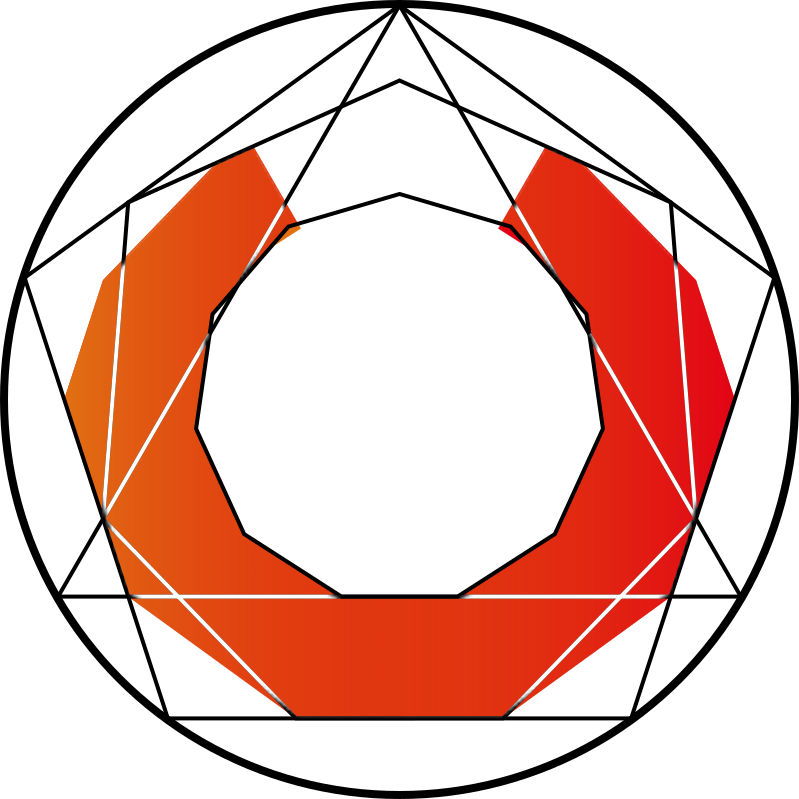
Prime Lattice
What the prime lattice is
The five prime families recognised by PPT — Du (2), Tri (3), Qui (5), Sep (7), Undec (11) — are mathematically independent. No combination of steps along one prime family’s axis can exactly reach a position on another prime family’s axis, because powers of distinct primes share no common factors. This independence means the families define genuinely separate dimensions of a multi-dimensional space. That space is the prime lattice.
Any musical position that can be described in PPT terms — any pitch, any
rhythmic duration, any timbral partial — is a point in the prime lattice.
Its coordinates are determined by how many steps along each prime axis are
required to reach it from a reference point. The comma system native to the lattice
encodes those coordinates as an ordered list of ±x/y steps, where x is the
index step (as a balanced parity magnitude around 0) and y is the bounded prime family
(e.g., 2 for Du, 3 for Tri, 5 for Qui, 7 for Sep, 11 for Undec). Du (2) is the only
entry that can appear at the coarsest open frame or at an interior depth.
A comma sequence produces a rational position, always. This is not a precision limitation — it is a closure property of the arithmetic described below. It is the single most important fact about the prime lattice, and it determines everything in the “Prime lattice paths are rational” section further down: how paths relate to JI ratios, why anchors are defined independently of paths, and what a comma actually measures.
Lattice coordinates and comma sequences
A comma sequence is an ordered list of steps along prime axes, written natively in ±x/y format. Each entry
moves from the current position to a new position in the lattice. The
sequence starts from a local anchor (defined by its parent boundary), and each step
refines the position within the subperiod local to that anchor. Note that the
use of the twelve chromatic solfège positions as anchors is a specific
implementation detail of Uniform Solfège, not a native constraint of the prime lattice itself.
Anchors themselves are not produced by comma sequences — see
Anchors and Prime Lattice Coordinates
for how they are defined.
The coordinates of a lattice point are determined by the complete path taken to reach it, not by any single entry. Two comma sequences that traverse the same axes in different orders may arrive at different positions. This path dependence is a requirement of the system, not an inconvenience.
Why path dependence is required
Du fractal navigation makes path dependence unavoidable. Each Du step specifies which half of the current subperiod to enter — positive for the upper half, negative for the lower half. A sequence of Du steps is a binary tree path, and the sequence of decisions is precisely what locates the position. Du’s two choices at any depth are branch-selectors, not point-labels. Collapsing a Du sequence to a single net value would destroy the tree structure entirely.
Once path dependence is required for Du, it is extended to all prime families for consistency and to permit mixed-prime fractal navigation. A sequence that interleaves Tri and Qui steps describes a path through the lattice that carries more information than the sum of its Tri and Qui components.
Generalised Fractal Descent and the Zero Index (Sustain)
For an odd prime p, the signed digit set is {±1, ±2, …, ±(p−1)/2}.
The formula for the position reached by a path of digits a_i with associated primes p_i is:
position = Σᵢ aᵢ / Pᵢ, where Pᵢ = ∏ⱼ₌₁ⁱ pⱼ (where every pⱼ in a valid path is a true prime: 2, 3, 5, 7, or 11)
Every term in this sum is a rational number (an integer divided by a product of integer primes), and a finite sum of rationals is rational. This is the formal source of the closure property stated above.
Importantly, the zero index (0) is a valid and crucial operator in the underlying math, acting as a Sustain. A zero over a prime family does not displace position; rather, it performs a period space reduction for the next level. The scale of the next level is determined by the product of the next level’s prime family and the prime family where the zero index was applied.
If the zero index is applied over another zero (an axis descent on zero), the reduction is determined by the exponent of the next prime family descent — structurally akin to carrying over the multiplier from a strike in bowling. This ensures the theoretical space has no unreachable gaps (“Cantor gaps”), even if the current visual writing system does not yet map all these internal routes.
The canonical resolution constant
The position formula above tracks Pᵢ as the running product of
whichever primes a given path visits — but for two paths to be
compared, combined, or validated against each other, it’s useful to fix
one common denominator large enough to hold every Base-mode address the
11-limit lattice can produce at once. That constant is:
N = 27,720 = 2³ × 3² × 5 × 7 × 11 = lcm(1, 2, 3, ..., 11)
the smallest integer divisible by every integer from 1 through 11.
Every Base-mode subharmonic N/n for n = 1…11 is therefore an exact
integer with zero remainder — the property that makes N the natural
shared resolution for the whole lattice, rather than an arbitrary round
number chosen for convenience.
N is a convenience constant, not a hard ceiling on resolution. A path
that goes deeper than the exponents N itself carries (for instance, a
fourth Du-fold, past 2³) simply addresses a finer grid nested inside
N, not an invalid one. N = 27,720 is best understood as the
coarsest common resolution that exactly covers every first-pass
11-limit construction this document describes, not as the maximum
precision the lattice is capable of.
Base and Reel: two coordinate modes on the same lattice
Everything above this point uses the Base-mode position formula:
position = Σᵢ aᵢ/Pᵢ, where each step contributes a rational fraction
of the current subperiod. This mode is exact for what it actually
targets — an equal subdivision of a period (a step of 1/5 genuinely
is one-fifth of the period, exactly) — which makes it the correct mode
for EDO-style addressing (12-TET, 31-EDO, 72-EDO) and for any target
that is itself a rational fraction of the period.
It is not, however, the only coordinate mode the lattice supports. A Reel-mode
step contributes the exact constant log2(pᵢ) (or, in a differently
based Reel, logₚ(pᵢ) for the declared prime base) rather than a
rational fraction standing in for it. Because logarithms convert
multiplication to addition exactly (log2(a·b) = log2(a) + log2(b),
with no error, for any a, b), a Reel-mode path’s position is:
position (DuReel units) = Σᵢ eᵢ · log2(pᵢ)
where eᵢ are signed integer exponents. This is not an approximation
of a ratio’s log2 position — it is that ratio’s log2 position,
restated as the sum of its own prime factorization. Any ratio built from
primes 2, 3, 5, 7, 11 to modest exponents is therefore reachable with
zero residual in Reel mode, for exactly the reason a rational
Base-mode sum can never reach it exactly: log2(pᵢ) is irrational for
every prime, and using the true irrational constant rather than a
rational stand-in for it removes the approximation error at its source.
This means the “Prime lattice paths are rational; JI ratios are logarithmic” section below describes a true and important fact about Base-mode paths specifically. It does not describe a limitation of the lattice as a whole, and should be read as scoped to Base mode throughout — see the note added to that section.
Which mode a given comma sequence is written in must be declared, the
same way a Period declares Base or Reel relative to its parent (see
Period).
A step is not ambiguously “a Tri step” independent of mode — a Base-mode
Tri step contributes a rational fraction of the period (k/3ⁿ for some
integer k); a Reel-mode Tri step contributes the exact irrational
constant log2(3). These produce different position types (a rational
fraction of a period, versus a real-valued log2 position) and must not
be silently mixed within a single path.
Where real commas belong, once Reel mode is available
With Reel mode established, it’s worth being precise about what a
comma actually is, since it is not “the gap between a path and its
single target ratio” — that gap is now provably zero, for a single Reel
target. A comma is what appears when two different Reel-address
routes are compared as though they reached the same pitch class: the
classic syntonic comma (81/80) is the gap between four stacked justly
tuned fifths minus two octaves, and a directly-addressed justly tuned
major third — two different, both individually exact, Reel constructions
that do not agree with each other. This is a genuine structural fact
about the independence of log2(3) and log2(5) (neither is a rational
multiple of the other, a consequence of unique prime factorization), not
an artefact of approximation. Base mode’s approximate, ever-shrinking
proximity to an irrational target (see “Nearest approach and rational
approximation of simple ratios,” below) is a different and genuinely
separate phenomenon from this cross-route comma, and the two should not
be described with the same vocabulary without this distinction stated.
Fold-count and continued fractions: a coarse but real measure of Base-mode approximation quality
For a single prime p, the question “how many Base-mode Tri (or Qui,
Sep, Undec) steps are needed before the approximation to n octaves is
below some threshold” is answered exactly by the continued fraction
expansion of log2(p) — a deterministic algorithm (not a search or an
observed pattern), producing a sequence of convergent step-counts
where the approximation is anomalously good for its depth. The
historically familiar case is log2(3): convergent step-counts of 12
and 53 produce the Pythagorean comma (≈23.46¢) and a strikingly small
≈3.6¢ residual respectively — which is the rigorous version of “why 12
notes,” not a coincidence.
Two things are worth stating plainly so a reader doesn’t over-generalise this:
- This is a single-prime tool. Cross-prime landmarks (e.g. 31-EDO’s
fame for approximating 5-limit content) are not explained by any
single prime’s continued fraction — 31 is not a convergent of
log2(5)alone. They are explained by an exact integer relationship between two primes’ approximations simultaneously (in 31-EDO’s case,4 × (best fifth) − 2 × 31 = (best third), exactly, as integers) — a simultaneous Diophantine approximation question, solved with different machinery (lattice reduction, e.g. LLL) rather than a single continued fraction. - There is no closed-form formula for the exact convergent sequence
itself —
log2(p)has no known special structure the way, say,√2does, so computing the actual convergents requires running the continued-fraction algorithm. What is available in closed form is a guaranteed search-space bound: Dirichlet’s approximation theorem guarantees a solution achieving comma < X cents exists withinq ≤ 1200/Xfolds, without needing to search to know that bound exists. Pinpointing whichqwithin that bound is the good one still requires the algorithm.
No exact inter-prime coincidence
Within a single prime family, the subdivision grid is regular and non-overlapping. Du steps halve the subperiod at each level; Tri steps divide it by 3; and so on. These grids are clean trees with no internal intersections.
When navigating exclusively via pure, single-prime descents (e.g., a pure Tri path versus a pure Qui path), exact coincidence across different families is mathematically impossible. This follows from the fundamental theorem of arithmetic: a pure p-family position always reduces to a fraction whose denominator is a power of p, and a pure q-family position always reduces to a fraction whose denominator is a power of q. For two such fractions to be equal (other than at 0), a power of p would have to equal a power of q — impossible for distinct primes.
The practical consequence: every distinct, single-family comma sequence describes a distinct lattice position. (Note that this non-coincidence applies strictly to pure paths; as noted below, paths built from mixed prime families can incidentally coincide — see Confluence).
Prime lattice paths are rational; JI ratios are logarithmic
This section states explicitly what the rest of the document implies for Base-mode paths specifically: the Base-mode position formula and a Just Intonation ratio’s true geometric position are two different kinds of number, and no Base-mode path can produce the second from the first. (See “Base and Reel: two coordinate modes on the same lattice,” above, for the Reel-mode case, where this limitation does not apply.)
A JI ratio’s geometric position (its angle around the period, or equivalently its distance in cents from the origin) is:
cents = 1200 × log2(ratio)
log2(ratio) is irrational for every ratio except a pure power of 2 — this
follows from the same fundamental theorem of arithmetic invoked above.
Meanwhile, a comma sequence of any finite length is, by the closure property
established earlier, always rational. A rational number cannot equal an
irrational one. This means:
- No finite comma sequence can land exactly on the true position of a ratio like 6/5, 5/4, or 16/15 (all irrational in cents-from-origin terms).
- A comma sequence can only ever get arbitrarily close — closer as depth increases, the same way a longer decimal expansion gets closer to an irrational number without ever reaching it.
- The residual gap between a finite comma sequence’s actual position and a ratio’s true log2 position is a genuine, quantifiable comma in the ordinary sense of the word — not an error to eliminate, but the natural unit of “how far off” a rational approximation sits.
- This limitation is specific to Base mode’s rational
Σaᵢ/Pᵢformula. A Reel-mode path reaches these same targets with zero residual — see “Base and Reel,” above — because it sums the exact irrationallog2(pᵢ)constants rather than rational approximations of them.
This is also why the twelve solfège anchors are not derived by walking a
comma sequence from Do. Each anchor is independently defined by its own
1200 × log2(ratio) value (or, for Fi, directly as the irrational point
±600¢ = 1200 × log2(√2)). Comma sequences instead do what they are
structurally suited for: navigating and refining position relative to an
anchor, at whatever rational precision the depth of the sequence provides.
See Anchors and Prime Lattice Coordinates for the actual anchor definitions and how paths relate to them as refinements.
Nearest approach and rational approximation of simple ratios
Although prime family grids never exactly coincide, they approach each other arbitrarily closely as depth increases, and — separately — a pure single-family comma path approaches a given target ratio’s true log2 position arbitrarily closely as depth increases. Both statements describe convergence, not identity, consistent with the previous section.
At depth 1, a single Tri step’s position is 1/3 of the period — 400¢ in a
1200¢ octave. The true position of the 3-limit fifth, 3:2, is 1200 × log2(3/2) = 701.96¢; a single negative Du half-step paired with Tri
(reaching the octave-reduced 3/2) still leaves a residual: the classic
Pythagorean comma, ≈23.46¢, is exactly this kind of gap, expressed as a
frequency-ratio residue (3¹²/2¹⁹) rather than as a position-formula
residue. It is the discrepancy between twelve compounded pure fifths and
seven compounded octaves.
At depth 4, four compounded Qui-generated major thirds and four compounded Tri-generated fifths produce positions that are nearly, but not exactly, the same frequency ratio; the residue is the syntonic comma, ≈21.51 cents (81:80).
The pattern is general: simple integer ratios are already-known targets (defined independently, by their own small-integer construction) that happen to be well-approximated by shallow nearest-approach constructions between prime grids. The ratio is not produced by the approach — it is what the approach is being measured against. This is the corrected version of a claim in earlier revisions of this document, which stated the reverse (that ratios are derived from, and posterior to, comma paths). That direction of causality does not hold: ratios and their log2 positions are prior and independent; comma paths can approximate them but not generate them exactly.
Comma complements and the Axis
Each local anchor defines a local subperiod — a bounded region of the lattice centred on that anchor. The commas array navigates within this region. It cannot cross into an adjacent anchor’s region; that would require selecting a different base reference, not adding a comma entry.
Within a local subperiod, every position has a comma complement: the position arrived at by inverting the sign of every step in the comma sequence. The complement is the mirror of the original path, reflected about the subperiod’s centre. The complement of a compression path is an expansion path of equal magnitude; the complement of a Du positive path is a Du negative path of the same depth.
Complement positions always sum to the full subperiod length — they are equidistant from opposite sides of the anchor’s local space. This is a direct consequence of the subperiod being a closed bounded interval with an origin (the Base) and a shared topological boundary (the Axis).
Crucially, Axis and Base define the boundary of the subperiod, with Axis acting as the reflection of Base across the local space. Axis is not a separate family. It is simply Du’s own first-step digit (±1/2), viewed relative to whichever local anchor’s frame is currently open, landing exactly on this shared boundary.
The comma complement relationship is internal to each local anchor. It does not extend across anchors. The complement of a position near a given anchor is another position near that same anchor.
Boundary Routing and Transient Excursions
In a strictly hierarchical lattice, pathing near the boundaries can create dead zones where an additive step would exceed local space limits (e.g., reaching Fa from Do). To resolve this, the pathing engine supports Transient Excursions (or Boundary Reflections).
This allows navigation to use the Du digit that represents the edge of the coarsest still-open frame as a non-terminal pivot; interior Du digits may not. By assuming an infinite tiling of the local space, a path can step to this edge and then cast a negative vector backward into the defined local bounds. As long as the terminal step resolves to a coordinate inside the known macro-bounds, the path is valid.
For the formal implementation details and mathematical foundations, see the Prime Lattice Boundary Routing specification.
Enharmonic equivalence
Enharmonic equivalence — two distinct representations describing the same musical position — exists at two levels in the prime lattice.
Within the spec: No two distinct (solfege, commas[]) pairs describe the
same lattice position. The representation is injective as established above.
There are no enharmonic equivalents at the level of the spec output type.
Across the spec: Enharmonic equivalence is a relation between spec output objects, not a property of any single object. It is defined by a function that takes two output objects and a temperament description and returns whether they resolve to the same position under that temperament.
Different temperaments define different equivalence relations over the same set of spec outputs:
- 12-TET declares a large number of equivalences simultaneously, collapsing the full lattice onto twelve points. Under 12-TET, many distinct comma sequences are equivalent because the temperament rounds them all to the nearest semitone.
- 31 EDO declares fewer equivalences, distinguishing Qui-based positions from their Tri-based neighbours while collapsing Sep and Undec positions that 12-TET also collapses.
- 72 EDO declares still fewer, distinguishing positions that 31 EDO treats as equivalent, covering the full comma space with fine resolution.
- Just intonation declares no equivalences — every distinct comma path is a distinct pitch. Temperament is therefore an application-layer decision about which near-coincidences to declare exact. The spec carries the full lattice information. The application chooses its resolution.
Path Equivalence and Confluence
Position depends on the product of primes used at each depth of a path
(through the Pᵢ denominators in the position formula), and different
orderings of the same set of prime steps generally produce different
Pᵢ sequences and therefore different positions — path dependence, as
established above, is the default. Occasionally, however, two differently
ordered paths land on the same rational value anyway, purely as an
arithmetic coincidence of the particular digits and primes involved (not
because of any general commutative law over the position formula itself,
which is not a multiplicative structure). This incidental collision is a
structural feature of the lattice worth naming, not a problem to engineer
around. It forms the basis of the Confluence relation — a documented
equivalence between distinct decision-paths that happen to arrive at the
same location. For more details, see
Path Equivalence and Confluence.
Relationship to Prime Period Diacritics
Prime Period Diacritics (PPD) is the writing system rendering of comma values. It provides visual glyph forms for a practical subset of the lattice positions most relevant to musical use. The PPD system is necessarily finite — a glyph set has a fixed number of members — while the lattice is infinite.
The relationship is analogous to decimal notation and real numbers: the decimal system can represent any rational number to arbitrary precision by adding digits, but cannot represent irrational numbers exactly. PPD can represent any lattice position to practical musical precision by combining glyph forms, but the lattice itself is finer than any finite glyph set.
PPD does not define the lattice. The lattice defines the space that PPD renders. Solfège anchors are the fixed points PPD’s glyphs sit closest to; comma-sequence refinements (and their diacritic renderings) describe distance and direction from an anchor, never a derivation of one. See Prime Period Diacritics — Overview and Glyph Forms for the visual specification.
Relationship to the Metric DuPeriod
The prime lattice applies equally across all timescales. A pitch position and a rhythmic duration occupy the same mathematical space — they differ only in their position along the Metric DuPeriod axis, which locates them at the micro or macro scale of periodic recurrence.
The subperiod concept is universal: a subperiod is any subdivision of a containing period, whether that period is a pitch octave or a rhythmic bar. The comma system navigates subperiods at any timescale without modification. Period-fixed and subperiod-fixed relationships (the mathematical basis for polyrhythm and polymeter respectively) are both naturally described in lattice terms — see Rhythm.
Relationship to established number-theoretic structures
Earlier revisions of this document claimed the prime lattice traced lineage to Regular Temperament Theory monzos and to the Stern-Brocot tree. On closer inspection, that lineage claim does not hold, and it’s worth being precise about why, since the surface resemblance is real even though the underlying structures are not the same:
- Not a monzo. A monzo is a prime-exponent vector describing a ratio
by multiplication:
ratio = ∏ pᵢ^eᵢ. It is order-independent by construction, because multiplication commutes. A comma sequence is order-dependent by construction (see “Why path dependence is required,” above) and is built from division of a bounded period, not multiplication of exponents. These are different operations producing different kinds of object — one an exact (possibly irrational) frequency ratio, the other a rational tree-address within a bounded space. Confluence (immediately above) is the closest point of contact between the two ideas, and even that is a coincidental collision rather than the general commutative equivalence a monzo would guarantee. - Not a Stern-Brocot tree. The Stern-Brocot tree is generated by a fixed
mediant operation and a fixed radix (it enumerates all rationals via
binary mediant descent). The prime lattice’s fractal descent instead lets
the navigator choose which prime’s radix to apply at each depth, and
supports the zero-index Sustain as a first-class period-reduction
operator with no Stern-Brocot equivalent. The prime lattice is better
described as its own variable-radix, signed-digit, author-directed
positional system — related in spirit to balanced base-
psigned-digit systems (e.g., balanced ternary) at any single depth, but not equivalent to either monzos or Stern-Brocot once mixed primes and Sustains are in play. - What is genuinely shared: the balanced signed-digit convention within a single prime family, and the general idea (common to all three structures) of representing a continuous space via nested, boundary-aware subdivision. That resemblance motivated the original comparison; it just doesn’t extend to the full mixed-prime, order-sensitive system PPT actually uses.
See also
- Period — the general Base/Reel coordinate-relationship concept, of which this file’s Base/Reel comma-path distinction is the lattice-specific instance
- Anchors and Prime Lattice Coordinates — how the 12 solfège anchors are independently defined via log2(ratio), and how comma-sequence paths relate to them as refinements
- Prime Families — the five generators and their perceptual properties
- Periodicity — the underlying phenomenon the lattice describes
- MIDI to Solfège Input Specification — the formal output type that encodes lattice positions
- Prime Period Diacritics — Overview — the writing system that renders lattice positions visually
- Just Intonation — the tuning theory context for prime lattice positions
- 72 EDO Grid — a practical finite approximation of the lattice used for diacritic placement
- Metric DuPeriod — the timescale axis across which the lattice applies
- Rhythm — period-fixed and subperiod-fixed relationships in rhythmic terms
- Path Equivalence and Confluence — how different paths can incidentally resolve to the same point
Knowledge Graph
status: stableused_by:- - foundations/anchors.md
- - foundations/period.md
- - specifications/prime-lattice-boundary-routing.md
- - extended/path-equivalence.md
- - ppd/index.md
- - ppd/glyph-forms.md
- - reference/metric-duperiod.md
- - domains/rhythm.md
- - foundations/prime-families.md
- - foundations/periodicity.md
- - specifications/midi-solfege-input.md
- - tuning/just-intonation.md
- - tuning/72-edo-grid.md