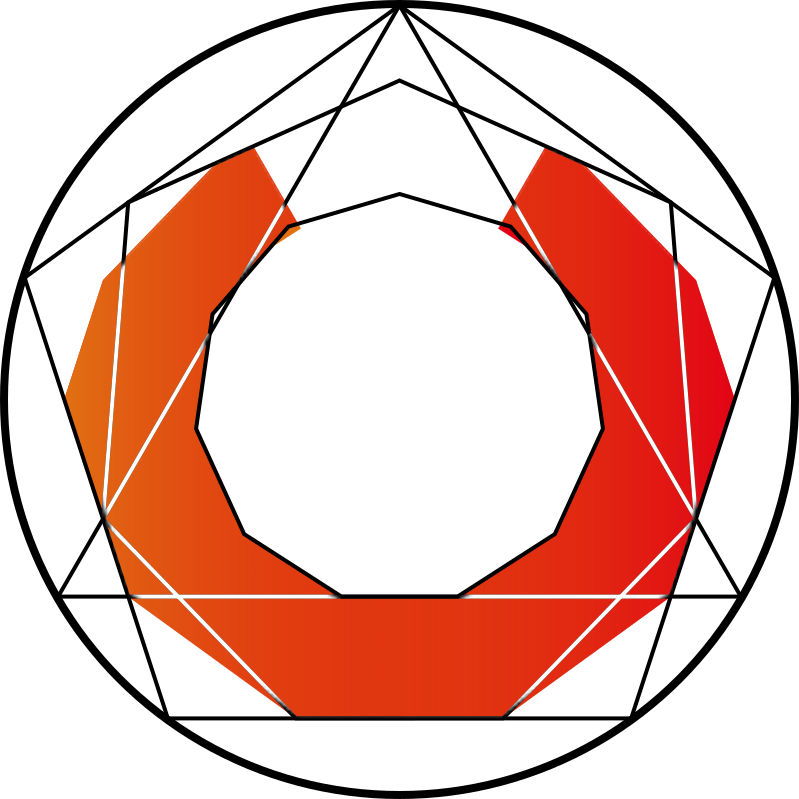
Du-Fractal DuTri Closure: A PPT-Native 12-Tone Tuning
This document specifies a 12-tone tuning system derived entirely from PPT’s axis-pass and fractal-descent grammar, using only the Du (prime 2) and Tri (prime 3) families — no reference to 5-limit or higher-prime JI, and no appeal to conventional 12-TET construction. The result is a reproducible, internally-consistent 12-pitch closure that is neither pure equal temperament nor pure just intonation, but a distinct third category native to PPT’s own generative grammar. It is proposed as a named construction for the OKF: the Du-Fractal DuTri Closure.
1. Background: the DuTri operator
The DuTri operator takes an anchor point and produces two flanking points at ±501.955¢ (i.e. the JI fourth, 4/3, and fifth, 3/2) from that anchor. Applied to Do (0¢), this yields the base triangle:
| Point | Cents | Ratio |
|---|---|---|
| Fa | 498.045 | 4/3 |
| Do | 0 | 1/1 |
| So | 701.955 | 3/2 |
Fi, the Du axis point (600¢, √2), sits at the symmetric midpoint between Fa and So (each 101.955¢ away), consistent with its role as the self-inverse axis of the octave.
2. Deriving Ra and Ti: applying DuTri to Fi
Applying the same operator to Fi (rather than Do) produces a second triangle:
- Fi × 4/3 = 4√2/3 → 1098.045¢ → Ti
- Fi × 3/2 = 3√2/2, octave-reduced to 3√2/4 → 102.06¢ → Ra
Both derived points sit exactly 498.045¢ from Fi, mirroring the way Fa/So flank Fi in the base triangle. The two triangles are structurally dual:
| Triangle | Anchor | Flanking points | Distance from anchor |
|---|---|---|---|
| Base | Do (0¢) | Fa (498.045¢), So (701.955¢) | 498.045¢ each |
| Derived | Fi (600¢) | Ra (102.06¢), Ti (1098.045¢) | 498.045¢ each |
Key property: irrationality is inherited, not resolvable
Because Fi = √2 is irrational and the DuTri operator only ever multiplies by rational JI ratios (3/2, 4/3), the derived points (4√2/3, 3√2/4) are themselves irrational and cannot be expressed as any simple integer ratio n/m. This is a hard mathematical fact, not a precision limitation: no amount of octave-reduction or re-expression will resolve Ra or Ti derived this way into rational JI form.
Practically, these derived points land close to but measurably distinct from both common reference tunings:
| Point | PPT-derived | 12-TET | Traditional JI |
|---|---|---|---|
| Ra | 102.06¢ | 100¢ (+2.06¢) | 16/15 ≈ 111.73¢ (−9.67¢) |
| Ti | 1098.045¢ | 1100¢ (−1.96¢) | 15/8 ≈ 1088.27¢ (+9.78¢) |
Both derived points sit within ~2¢ of 12-TET (below just-noticeable difference) but ~10¢ from the conventional JI semitone/major-seventh. This makes the DuTri-derived Ra/Ti a genuine third category: not tempered by design, not rational by construction, yet perceptually indistinguishable from equal temperament while being generated by a completely different mechanism (rational Tri-dressing on an irrational Du axis).
3. Fractal descent: unlocking Me and La
A one-level fractal descent of Du bisects the octave again, this time bisecting each half. This produces the two remaining nodes of the equal tempered diminished 7th chord:
| Point | Cents | Ratio |
|---|---|---|
| Me | 300 | 2^(1/4) |
| La | 900 | 2^(3/4) |
Together with Do (0¢) and Fi (600¢), these four points form the complete symmetric diminished-7th skeleton — all four points are powers of 2^(1/4), equally spaced at 300¢ intervals, and each is self-inverse under octave reflection the way Fi is.
4. Full 12-tone closure
Applying the DuTri operator (±498.045¢) to each of the four Du-fractal anchors (Do, Fi, Me, La) produces the remaining eight pitches. Combined with the four anchors themselves, this closes the full chromatic 12-tone set:
| Solfège | Cents | Derivation |
|---|---|---|
| Do | 0.000 | Du root |
| Ra | 101.955 | Fi + 3/2 (octave-reduced) |
| Re | 198.045 | La + 4/3 |
| Me | 300.000 | Du fractal descent (2^(1/4)) |
| Mi | 401.955 | La − 4/3 |
| Fa | 498.045 | Do + 4/3 |
| Fi | 600.000 | Du axis (√2) |
| So | 701.955 | Do + 3/2 |
| Se/Le | 798.045 | Me + 4/3 |
| La | 900.000 | Du fractal descent (2^(3/4)) |
| Te/Li | 1001.955 | Me + 3/2 |
| Ti | 1098.045 | Fi + 4/3 |
Step pattern (ascending, in cents)
101.955 – 96.09 – 101.955 – 101.955 – 96.09 – 101.955 –
101.955 – 96.09 – 101.955 – 101.955 – 96.09 – 101.955
This is an alternating pattern of eight ~102¢ steps and four ~96.09¢ steps, arranged with exact 3-fold symmetry (the pattern repeats every 400¢). This combined symmetry — 4-fold from the dim7 skeleton, 3-fold from the DuTri dressing — is consistent with 12 = 4 × 3, and gives the tuning a structural regularity distinct from the uniform 100¢ steps of 12-TET.
5. Classification: what this tuning is and isn’t
- Not 12-TET. Every pitch lies within ~2¢ of its 12-TET nominal (individually inaudible as a difference), but the underlying step structure — alternating ~102¢/~96¢ steps rather than uniform 100¢ steps — is fundamentally different from equal temperament’s construction.
- Not 5-limit JI. No 5-limit ratios appear anywhere in this construction. The entire set is generated from only the primes 2 (Du) and 3 (Tri) — i.e., pure 3-limit JI dressing applied to a 2-limit equal-tempered skeleton.
- A genuine PPT-native object. Every non-tonic degree in this set is irrational relative to Do — nothing in the twelve pitches besides Do itself is expressible as a rational ratio. This is a strong, specific, checkable structural claim that distinguishes this construction from any historical tuning tradition (JI systems are built to maximize rational simplicity; ET systems abandon rationality entirely in favor of uniform steps; this construction does neither).
6. Physical/geometric intuition (for pedagogy section)
- Du moves (bisection) are rotationally trivial. On a circular (angle-native, log-frequency) representation of the octave, finding any Du-fractal node is just constructing an angular bisection — halving an angle repeatedly. This is the single most primitive compass operation there is, and it generalizes to unlimited fractal depth with no increase in difficulty.
- Tri moves are rotationally hard. The 3/2 and 4/3 generators do not correspond to any bisection of the circle — their angular position involves log₂(3), which is not reachable by repeated halving. Even in an angle-native representation, constructing a Tri move requires a genuinely different mechanism (a logarithmic-spiral or mean-proportional construction), not a bisection.
- Implication for the OKF: the physical/geometric difficulty of constructing a prime’s generator tracks the prime family itself, not just the resulting interval size. This is independent supporting evidence for treating Du and Tri as structurally distinct operation types within the PPT grammar, rather than two instances of the same kind of move.
See also
Knowledge Graph
status: stable